
Staying the course
Leaving the golf course unchanged means most people lose, and it makes the rest of the plan harder to pay for.
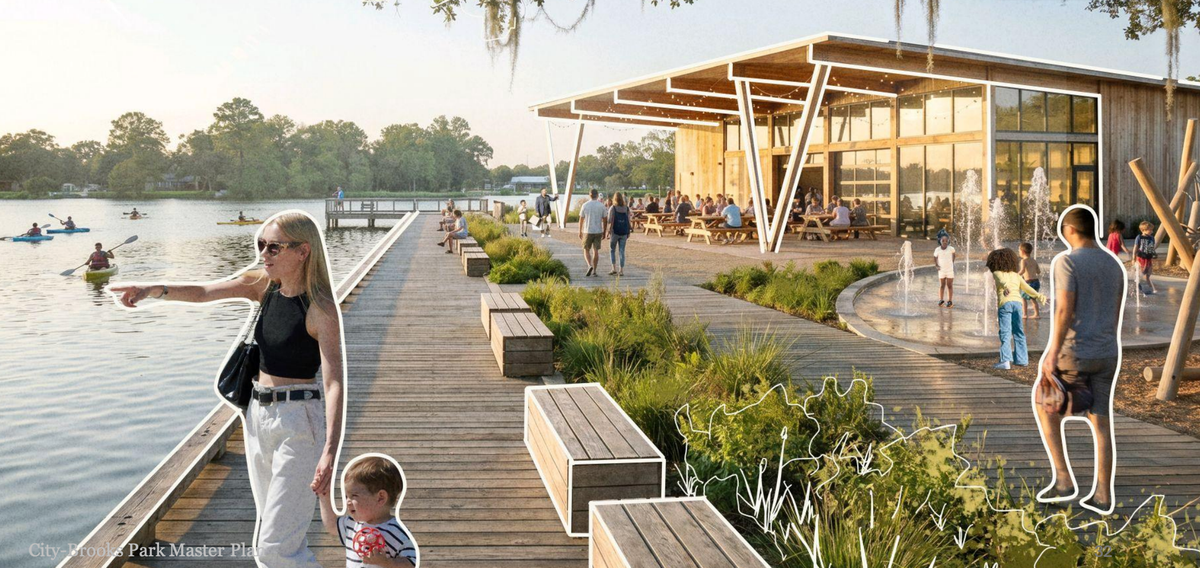
BREC Superintendent Brooks Williams said in a Friday release that he's committed to keeping the City Park golf course in its "historic layout." If that holds, he has set aside a key part of the plan Sasaki drew for the park.
Why it matters: The golf course is the hinge of most of the design of one side. Leave it as it is, and the City Park side looks much like it does today. Then there's the bill. Funding for most of the City-Brooks Park master plan will need to be raised privately, and that would become harder to accomplish without the changes to the golf course.
- Here are our takeaways if the course is not changed.
1. What park users lose
Except for the area near the Baton Rouge Gallery, the City Park side would stay about the same.
Here's what would not be built:
- A City Park lakefront. The road would have been rerouted so the land met the water, with greenspace on the shore and a place to rent boats.
- A terraced lawn and a nature play area by the water.
- A restored bayou along Dalrymple Drive, reshaped, with a linear park running beside it.
- A better golf course. That's the planners' description. They hired golf course architects to help redesign it.
2. Shoving everything to Brooks Park and calling it a win
For three decades, some residents have pushed to build up Brooks Park, and they've cheered every time the City Park side was left alone, except for a croquet court. With the golf course unchanged, they get that again.
Some of those residents call the golf course a "crime buffer." RedEye reporters have heard them whisper it many times. A buffer keeps things apart. Here, the course keeps their homes at a distance from the people a busier park would bring in: Black and white, rich and poor.
Yes, but: Brooks Park deserves the money. Its pool dates to Jim Crow Baton Rouge, when Black families were kept out of the bigger pool across the park. BREC proposes spending $28 million on a new pool complex and will ask the state for $22 million. The pool, a new track and the rest of the Brooks Park plans would begin to answer for the racism that shaped the park. Done well, they'd draw people from across the city's racial and economic lines and give Baton Rouge a chance to build community.
3. The money gets harder
Raising money for a park requires trust. BREC has squandered much of it by abandoning the plan its own process produced, including changes to the golf course. Major donors now have reason to question whether their gifts will deliver what BREC promises.
There's also less to give to. Bold ideas are what get donors to write checks. Take them out, and what's left is a City Park that comes along slowly and will most likely be unremarkable. That was never BREC's goal.
4. The conservancy question
A Trust for Public Land study names a realistic, broadly supported master plan as a hallmark of conservancies that work. In BREC's master plan, a conservancy has been proposed to build out and maintain the lakes and City-Brooks Park, taking over for several public agencies that residents have complained aren't keeping the lakes and their banks in shape. What happens to it now? Will BREC, LSU and the city-parish follow through with the conservancy?
5. Insulated from the voters.
Voters approved BREC's renewal of a property tax for capital improvements in June. The agency doesn't have to be politically responsive to the voters for a decade.
What to watch: State Rep. Dixon McMakin worked his way into the golf course fight with a plan of his own, one he proudly built with AI. He has ruffled feathers in his district while locking in support from residents who want little to change. Watch what the Catholic High grad does next, and whether it serves East Baton Rouge or groups that have rallied behind him.
The bottom line: In September, Williams said the planning let BREC "dream a little and envision what could be at that site." Friday's release puts most of that dream back on the shelf. City Park keeps its nine holes, and Baton Rouge loses a good deal of what could have been.
There's a cost inside BREC, too. Williams is bowing to some commissioners who are too scared to take the heat. If that becomes the habit, BREC will splinter and drift every time a project that shapes the city's future meets loud, forceful opposition.