Baton Rouge's faulty growth math
Urban3’s Joe Minicozzi says value per acre shows which development pays its way and which sends the bill to everyone else.
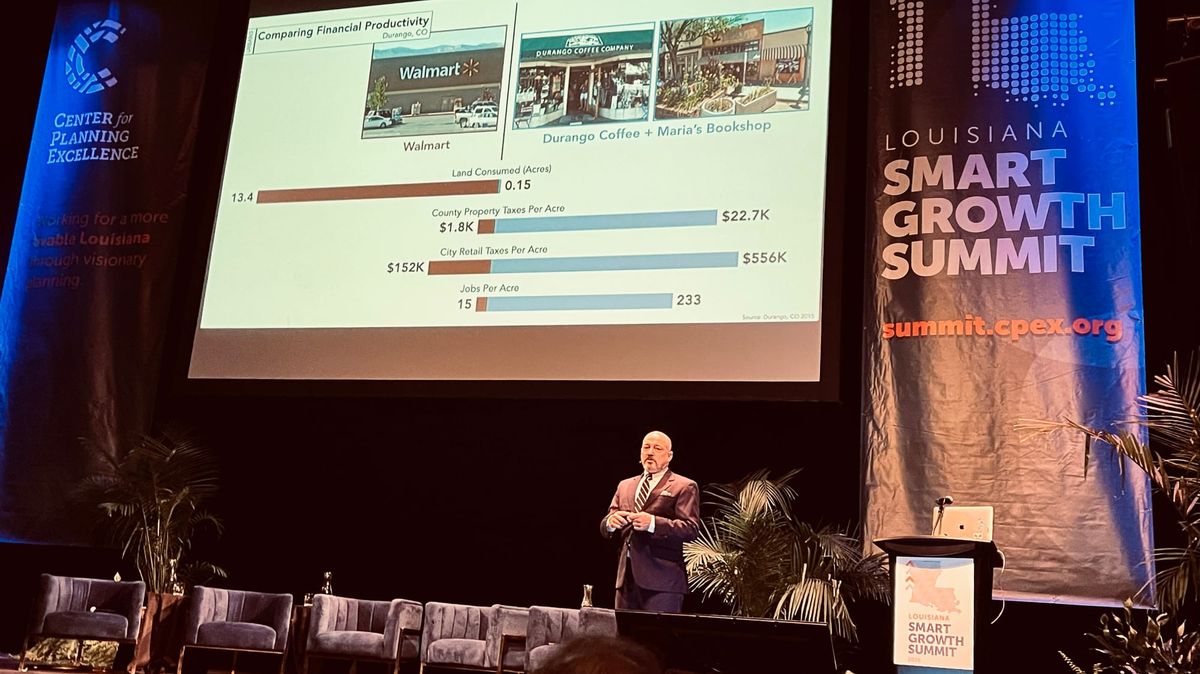
A coffee shop and a bookstore in Durango, Colorado, pay $22,700 in county property tax per acre—the Walmart down the road pays $1,800. That gap, Urban3 founder Joe Minicozzi told the Louisiana Smart Growth Summit on Thursday, is the math Baton Rouge and other Louisiana governments aren’t running before approving growth.
Why it matters: Every acre a city or parish grows outward comes with a maintenance bill, and Minicozzi’s maps show which development covers it and which sends it to taxpayers elsewhere.
- East Baton Rouge wasn’t specifically studied, but based on the realities of other parishes and cities, including Lafayette and Shreveport, it’s pretty clear suburban growth here is being subsidized—and that includes St. George and the other outlying cities.
Potency pays: Urban3 measures property tax per acre instead of total value. In other words, its metric is similar to the way most of us evaluate our vehicles based on miles per gallon, rather than miles per tank.
- A renovated downtown building in Asheville, North Carolina, jumped from $300,000 to $11 million in taxable value on 0.2 acres, while a Walmart worth $20 million sprawls across 34 acres.
- Across 60 cities in 21 states, Minicozzi found a six-story mixed-use building yields 274 times the county property tax per acre of a single-family home, against 6.7 times for a Walmart.
- A two-story building in Delray Beach, Florida, for example, is valued at $68.1 million an acre, against $1.5 million for the average Walmart.
Minicozzi isn’t arguing that every acre should be downtown, only that local governments use a better model to evaluate the value of a new development pitch and decide whether the tax revenue generated will cover long-term maintenance costs, or whether it’s OK to ask existing areas to subsidize those bills.
What he said: “The more that I waste your land, the lower the taxes I pay,” Minicozzi said, making the case that density is more efficient for covering costs and generating tax revenue than low-density development.
Roads are liabilities: Governments list roads as assets, but Minicozzi said nobody can sell one, and each comes due for replacement about every 50 years. In Baton Rouge’s case, the lifespan is often far less.
- He called building new roads to pay for the old ones a “Ponzi scheme.”
- Lafayette’s population grew 3.5 times from 1949 to 2015, but pipe per person grew 10 times, fire hydrants per 1,000 people 21 times and median household income 1.6 times.
- Asphalt rose 45% and fire trucks 87% from 2020 to 2026, while a 2.5% annual revenue cap—his Massachusetts example—allowed 15%.
Calling Baton Rouge: East Baton Rouge gets about $16 million a year for road overlays, transportation and drainage director Fred Raiford told RedEye in June, and “it don’t go very far.”
- New subdivision roads in the parish often need rebuilding in about 10 years, program manager Dan Rosenquist said—the “permanent liability” Minicozzi described once a developer hands a road to the public.
- Without a new program, the parish will be “out of rehab money” in 2030, Raiford said.
Louisiana’s setup: The state’s tax structure, Minicozzi said, leaves local budgets exposed.
- Louisiana leans on sales taxes more than most states—East Baton Rouge’s rate is among the nation’s highest—which means a recession hits city and parish budgets hard.
- State law assesses commercial buildings at 15% of market value and homes and land at 10%, a split he said most people never think to question.
Uneven assessments: Minicozzi argued assessment models overcharge cheaper homes and undercharge expensive ones.
- In Asheville, he said, the bottom 40% of homeowners overpay while the top 60% underpay—a $7 million annual transfer.
- University of Chicago researcher Christopher Berry found the same pattern nationwide, with homes in the bottom 10% of sale prices assessed at twice the share of price of the top 10%.
- Louisiana is a non-disclosure state, so assessors—including Brian Wilson in Baton Rouge—can’t see sale prices. “They’re just guessing,” Minicozzi said.
The fix: Minicozzi calls it “geo accounting”—putting the numbers on a map so anyone can see who pays and who gets subsidized.
The bottom line: Every city approves developments that require subsidies to cover ongoing costs; the question is whether East Baton Rouge cities are doing it by choice—or bad math?