What would Olmsted do?
As Baton Rouge considers the future of City-Brooks Park, there are grander lessons to learn from the father of American landscape architecture.
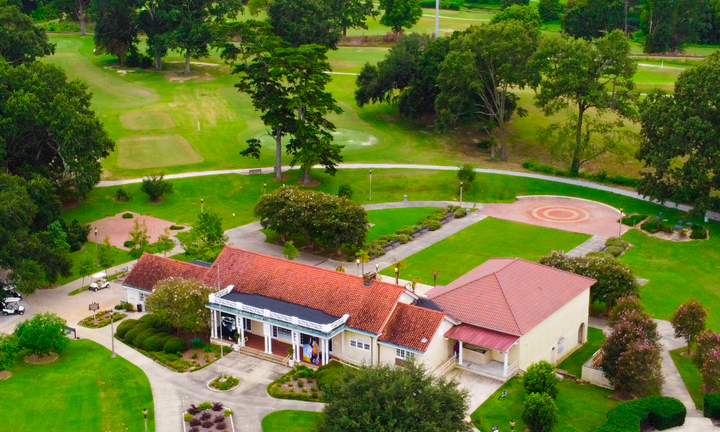
The debate over City-Brooks Park has been loud, contentious and, at times, more about golf than about the park. Sasaki Associates—the firm BREC hired to develop the master plan—has drawn criticism for a process some stakeholders believe arrived at its conclusions before the public input did.
Now, with a June 11 public meeting approaching, Sasaki and the Baton Rouge Area Foundation are pushing for a private conservancy to manage and operate City-Brooks Park, the University Lakes and Wampold Beach as a unified system.
Plan Baton Rouge III—the first update to the city's downtown master plan since 2009, also led by Sasaki—has already been unveiled, with greenway connections to City-Brooks among its recommendations.
Four major public assets—the park, the lakes, LSU's campus and the downtown riverfront. Three miles connect them. Two planning processes. One firm holding both pens.
It's worth asking: what would Frederick Law Olmsted do?
Why it matters: The decisions made in these two planning processes—separately or together—will shape how Baton Rouge functions as a city for the next generation. Olmsted's philosophy offers something rarer than a master plan. It offers a way of seeing.
Who he was: Olmsted is the father of American landscape architecture. Central Park. Prospect Park. Niagara Falls. The grounds of the U.S. Capitol. The park systems of Buffalo and Louisville. Audubon Park in New Orleans.
- His firm shaped how American cities think about public space—not as an amenity, but as infrastructure. To Olmsted, parks weren't places to put things. They were systems designed to connect people to one another and to the city around them.
- His core belief was straightforward: the urban grid exhausts people. Nature restores them. But only if the experience is unbroken—a continuous landscape where the city disappears and the eye can finally rest.
Surprising twist: Here's what most people don't know: almost none of it was natural.
- The rolling meadows, the gentle hills, the seemingly wild edges of Central Park—Olmsted built all of it. He moved earth, planted trees and shaped shorelines to manufacture the illusion of wilderness in the middle of a city.
- And when roads or railroads had to pass through, he didn't fight them. He buried them—grade-separated beneath the landscape so that a walker crossed a thoroughfare without ever knowing it was there. The infrastructure disappeared. The vista remained.
In Baton Rouge, Olmsted wouldn't need to manufacture the beauty. At City-Brooks Park and the University Lakes, it already exists.
The result is something powerful and necessary: a moment when a person stops, looks out across water and trees, and thinks—this is ours, and it's extraordinary.
The local connection: Olmsted's fingerprints are already here.
- In 1921, Frederick Law Olmsted Jr.—son of the founder and principal of the firm—drafted the master plan for LSU. He tied the campus to its topography rather than imposing a grid on it. The cruciform quadrangle, the Spanish tile roofs, the Greek theater tucked into a wooded hillside, the stately oaks and broad magnolias celebrated in the Alma Mater—all of it flows from that vision.
- The current campus remains largely faithful to it more than a century later.
The University Lakes aren't adjacent to that legacy. They are part of it.
What Olmsted would see: He would look at the political boundary between BREC's City-Brooks Park and LSU's University Lakes and call it what it is—a design failure. He wouldn't see two projects. He would see one fractured landscape desperate to be stitched together.
- The University Lakes have, for decades, been exactly what Olmsted envisioned: an exercise promenade where walkers, joggers and cyclists navigate the shoreline every morning, evening and throughout the weekend, with waterfront homes on one side and open water on the other.
- The bones of the system are already there. His model—the Emerald Necklace deployed across Boston, Louisville and Buffalo—was a fluid, unbroken sequence of green spaces connected by parkways carrying the park's energy deep into the urban core. He didn't build destinations. He built systems.
More than a feeling: People didn't know they were in an Olmsted park. They just knew it was a place they really loved.
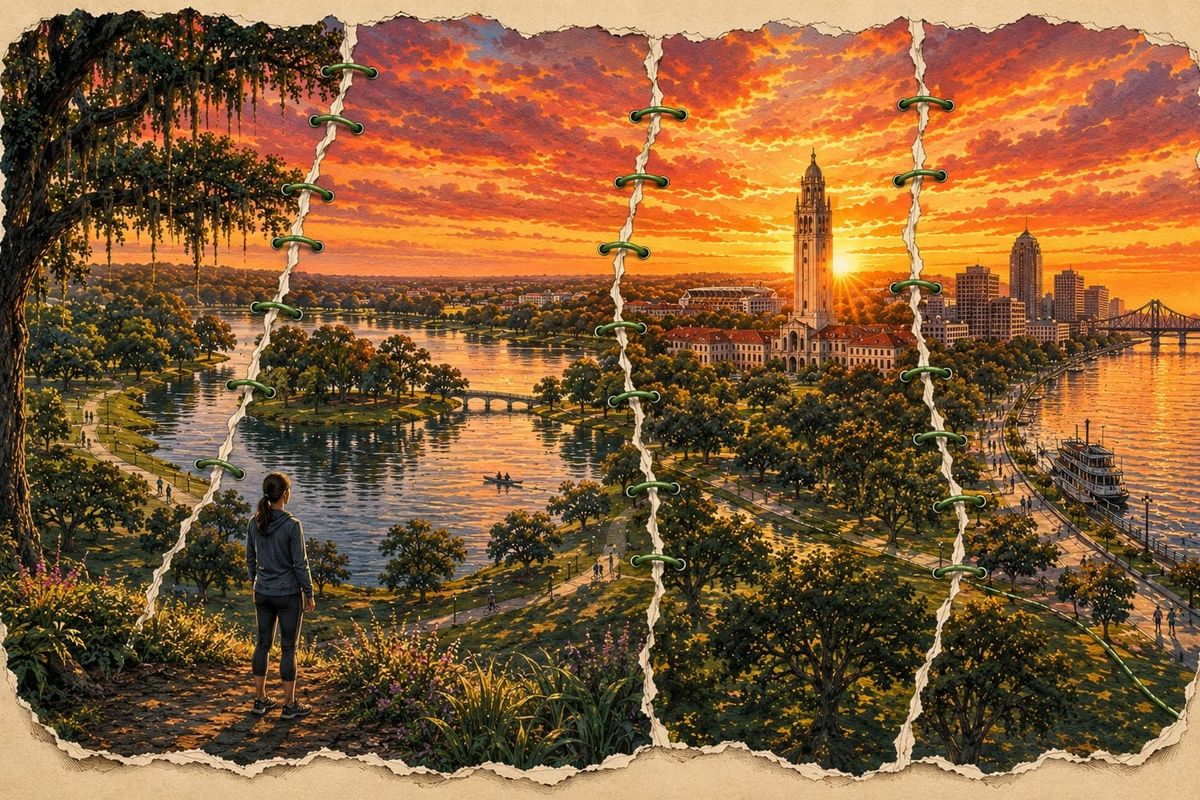
Applied here, that means grade-separated crossings where a walker moves from the park to the lake trails without dodging a car or glancing down at a railroad track. Dense plantings at the edges to block out traffic noise entirely. And carefully framed vistas—manufactured, as always—where the landscape opens up and delivers something Baton Rouge has but hasn't fully claimed. There's a spot at City Park, near what's now the golf course's fourth hole, that offers a stunning panorama of the sun-kissed lakes, the LSU campus and its campanile rising majestically from the oaks, the setting sun providing the spiritual illumination in the western sky.
The I-10 bridge cuts across that view—an ugly interruption Olmsted would have regarded not as a resignation but as a design challenge.
The double commission: Sasaki is simultaneously steering Plan BR III and the City-Brooks master plan while the $79 million University Lakes restoration is underway.
- Olmsted would not see three separate projects. He would see a once-in-a-generation opportunity—and he would demand Sasaki treat it that way. The park, the lakes, Wampold Beach, the LSU campus, the Nicholson corridor and downtown Baton Rouge should function as connected gathering spaces—a continuous thread of public life running through the heart of the city.
- In a parish needing to find ways to come together, that thread isn't a luxury. It's the point.
Nicholson Drive is the missing link. Tree-lined, underloved, blighted but surrounded by unrealized potential, it is the corridor that could carry the park's energy from the north gates of campus to downtown and the Mississippi River.
Cities that made those connections—Atlanta's BeltLine, Indianapolis's Cultural Trail, Dallas's Katy Trail—didn't just build parks. They built economic engines that reshaped development and gave residents a reason to stay.
Where Olmsted would push back: He would applaud the ecological engineering at the lakes—using dredged material to build naturalistic wetlands that filter stormwater. It's infrastructure masquerading as art. But he would resist the volume of programmed commercial activity in Sasaki's City-Brooks proposals.
- Tennis courts, a track, croquet, putt-putt, food and drink concepts, an amphitheater—each one is a task hub. Olmsted argued that cluttering a landscape with activity-driven destinations keeps the brain in navigation mode.
- His standard wasn't what a park makes people do. It was how a park allows people to be.
The bottom line: Baton Rouge has the three miles. Sasaki has a double commission that almost never happens. The June 11 meeting is the community's best chance to insist that what gets built gives every family in this parish a reason to claim this park as their own.