Three years of restaurant openings, mapped
A new restaurant is more than a menu. It's a signed lease, a construction loan, and a bet on a neighborhood. We tracked where those bets are being placed.
Restaurant openings are a leading economic indicator. Before the ribbon-cutting, someone signed a lease, pulled permits, hired contractors, and wagered real money that a neighborhood was worth the risk. Track the openings and you track the investment thesis.
So we did. RedEye searched publicly announced restaurant openings over the last three years to map how the city is developing — and where the money thinks Baton Rouge is going.
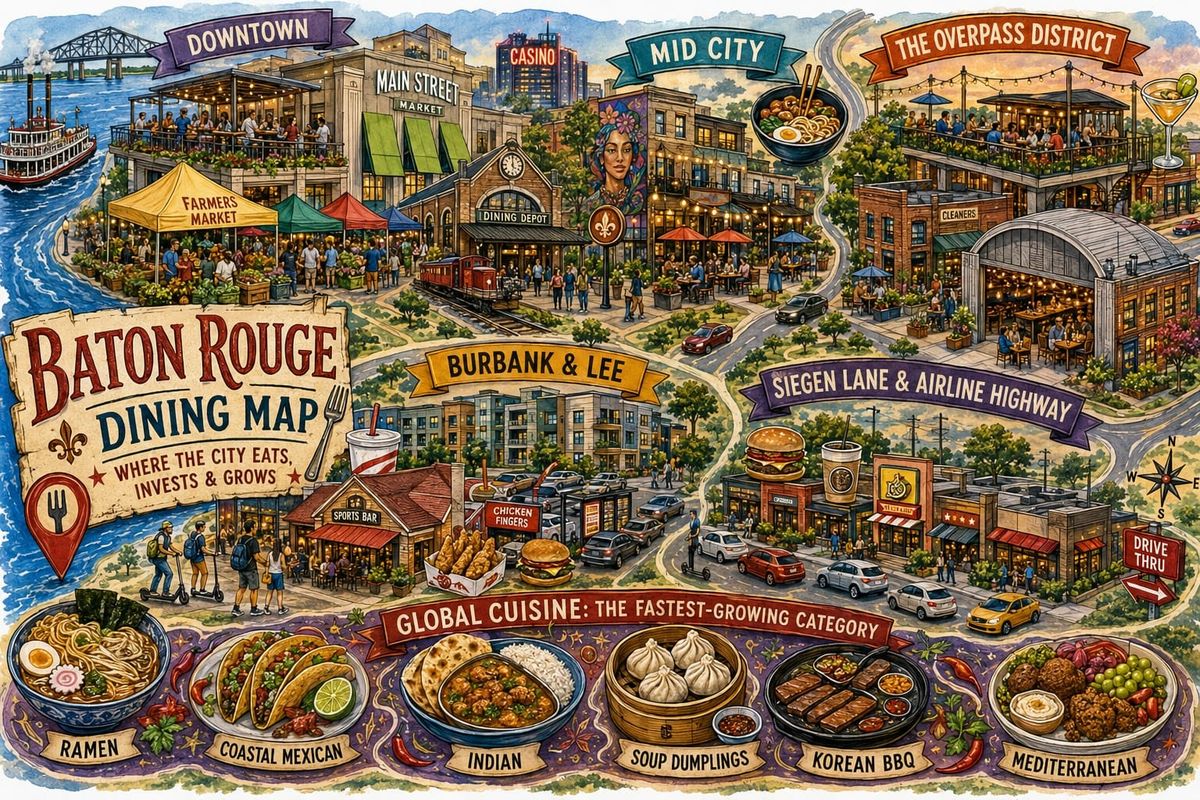
The Perkins Road Overpass District is still the city's dining anchor.
Three distinct concepts, three different owners, one neighborhood they all chose independently—and that's the tell. Luna Cocina opened a rooftop bar in the old Kean's Cleaners building. The Colonel's Club converted a former airplane hangar. City Roots is adding a third location there this fall. The district grew organically over a decade, sits near neighborhoods with disposable income, and offers easy interstate access from the suburbs.
Downtown is being built around casinos and a public market.
Bally's didn't just bring gambling onshore—it brought five restaurants into the restored Illinois Central train station at the Dining Depot: Hearth Pizzeria, Shuck's Oysters, a wine bar, a coffee shop, and a cafe. The Main Street Market added four new concepts after renovations. This is top-down development, anchored by institutional investment rather than organic neighborhood growth.
Siegen Lane and Airline Highway are the franchise belt.
The chains go where the cars are, and there's no doubt Siegen has the traffic. Bun's landed in the old Burger King shell. A third Panda Express chose the corridor. Bao and Dumpling opened on a stretch that has become a row of Asian restaurants.
Burbank and Lee has the highest restaurant density in the parish—and it's still growing.
Most of the restaurants there are new or just a few years old: Dutch Bros., Panda Express, Fuego, McAlister's, Arby's, Chick-fil-A. North Carolina-based burger chain Cook Out announced it's coming next. The formula is simple: thousands of LSU students in nearby housing who want food fast and cheap. The operators know their customer.
College Drive may have hit its ceiling.
Other than a new sports bar taking over Drago's space, the high-traffic corridor has settled into a stable roster with no obvious room to grow. As Yogi Berra once put it: "Nobody goes there anymore, it's too crowded."
Mid City is growing local, with a few chains mixed in.
Daruma Ramen is new on the road. The team behind Rocca, Modesto and Lit Pizza is reviving Fleur de Lis. The mix of cuisines reflects Mid City itself—arguably the most diverse area of the parish—drawing from its surrounding neighborhoods and a citywide audience seeking variety.
Global cuisine is the fastest-growing category in the portfolio.
In 18 months, Baton Rouge added a ramen shop (Hikari), a coastal Mexican concept (Veracruz), three Indian places (Gunpowder, Aroma and soon Spice Junction), soup dumplings (Dumpling & Bao), all-you-can-eat Korean BBQ (KPOT) and a Mediterranean fast-casual (Starbox Falafel). This is a diverse city catching up to its own demographic appetite.
The bottom line: Three years of openings point to the same conclusion. The Overpass District remains central to serious dining investment. Mid City draws from across the parish on the strength of its variety. And wherever you find cars and students, you find chains—because that's exactly what the market ordered.

We watch public meetings.
So you can watch something better.
RedEye turns three hours of motions, posturing and “brief remarks” into a few minutes of useful news. Support local journalism that respects your time.