
College Drive reality
The most significant intervention on Baton Rouge's most notorious corridor in decades is underway—sort of.
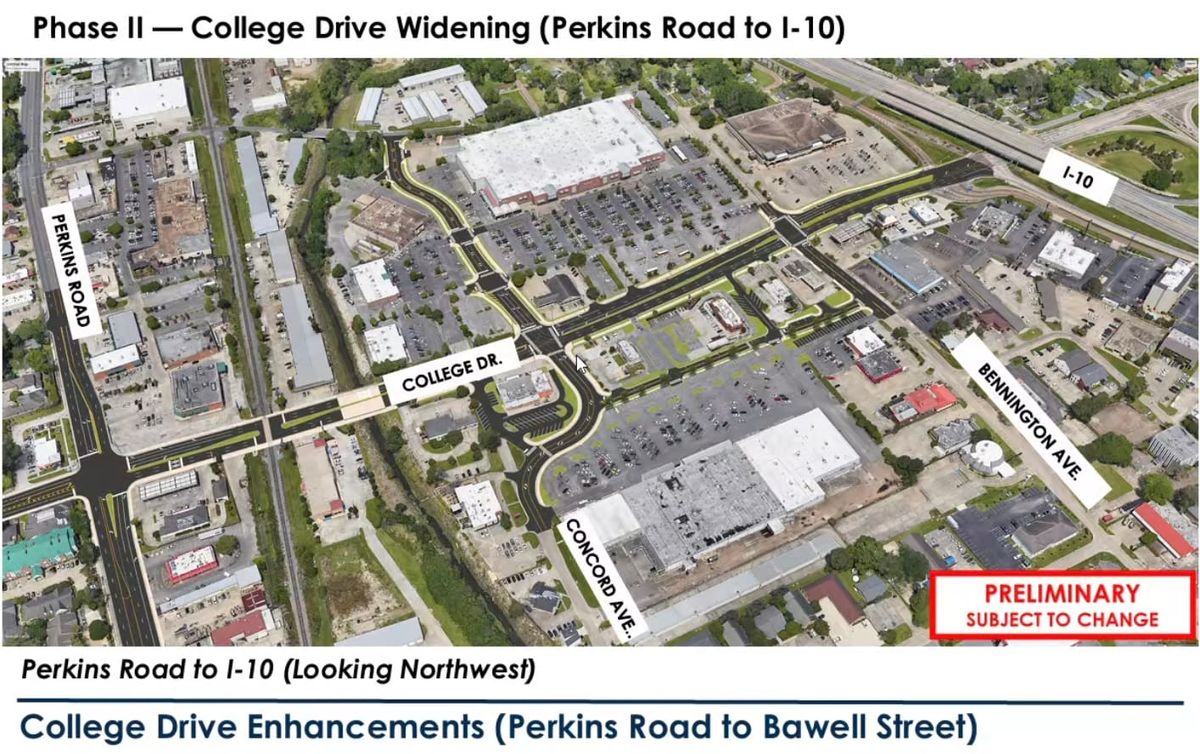
A $98 million plan to ease congestion on one of Baton Rouge's most congested corridors is moving—slowly—toward construction.
MovEBR's College Drive Corridor Enhancement project covers 3,900 linear feet between Perkins Road and Bawell Street. Construction advertisement is estimated for 2028. The project has been broken into three phases.
Why it matters: About 49,000 vehicles pass through the College Drive and Perkins Road intersection every day. MovEBR projects that the number will reach 50,500 by 2042, even with mitigation. This is the most comprehensive plan on the table.
Phase 1—The backage road: A new two-lane road running parallel behind the commercial strip between Concord and Bennington avenues pulls local commercial traffic—drivers turning left into driveways—off College Drive and onto a signalized parallel route.
- Design is complete. Right-of-way acquisition is underway.
- Includes a relocated Concord intersection.
- Perkins Road intersection improvements are projected to reduce delay by up to 33%.
Phase 2—The northbound lane: A new northbound lane from Perkins Road to I-10 targets the corridor's worst directional movement. MovEBR projects it cuts peak-hour travel time between Perkins and I-10 by up to 43%. Funding not fully confirmed.
Phase 3—Concord Avenue extension: Extends Concord Avenue westward to improve grid connectivity between College Drive and Bennington Avenue. Currently unfunded.
The ramp problem: A DOTD flyover ramp that opened early last year created an isolated right lane, forcing a turn onto Corporate Boulevard. Drivers who don't want to turn sit. Traffic backs up. A fix has been identified. It has not been implemented.
Lee Drive: A separate MovEBR project widens Lee Drive, adding a center turn lane between Highland Road and Perkins Road. Cost: $42 million. Design 90% complete. Right-of-way acquisition underway. Construction expected in 2029. The project adds capacity to a key parallel corridor—and will likely bring additional volume to the College Drive and Perkins Road intersection where it terminates.
The Bottom Line: Phase 1 is funded and moving. Phases 2 and 3 are designed but not fully financed. At full build-out, the plan addresses access management, capacity and grid connectivity without adding lanes to College Drive itself. Whether that is enough for a corridor projected to carry 50,500 vehicles a day by 2042 is, at best, an open question.