
College Drive dreams
What if Baton Rouge's most notorious parking lot could actually be fixed—and why it probably never will.
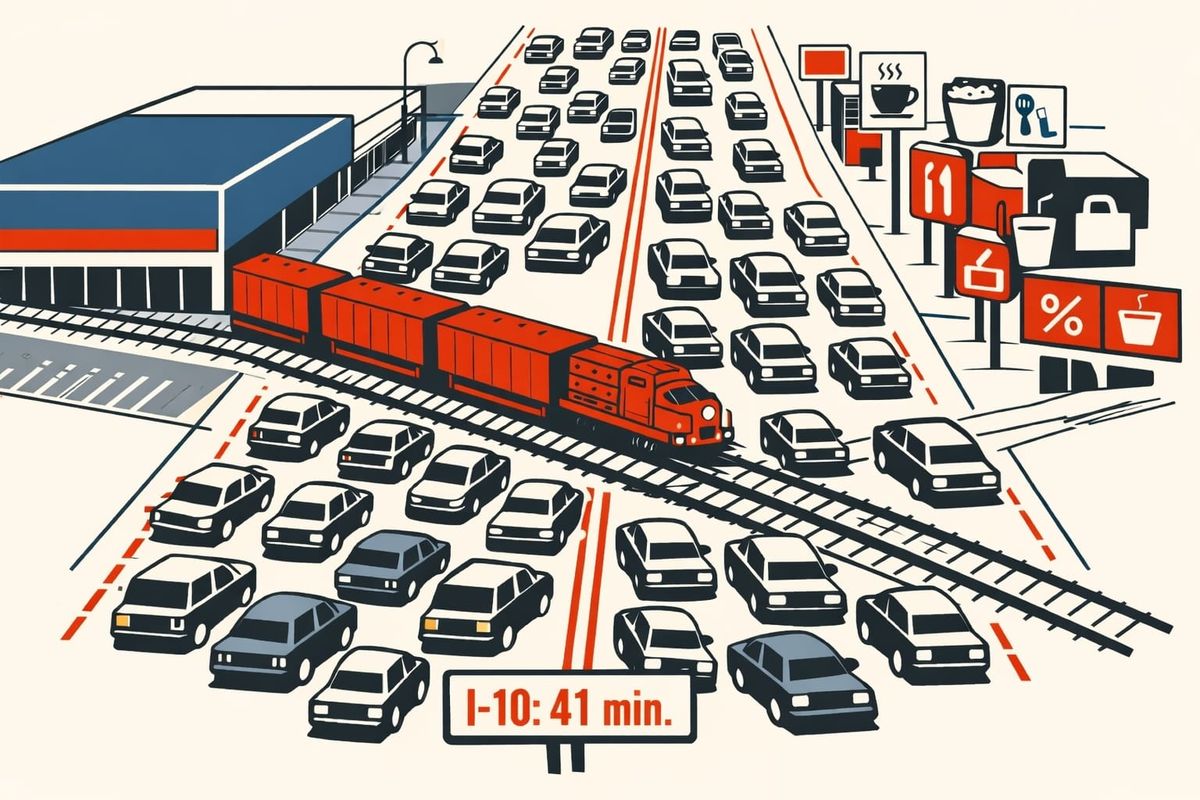
Somewhere on College Drive right now, a train is crossing.
You know the one. The tracks just north of Perkins Road. A freight train lumbering through at four miles an hour while 200 cars sit and reconsider every decision that led them here. It is the perfect metaphor for College Drive—a road so thoroughly, cosmically defeated that even the railroad gets a turn.
College Drive is Baton Rouge's great shared misery. A five-lane parking lot moonlighting as a highway, a neighborhood street, an interstate on-ramp queue and a fast-food drive-through—all at once, all day. The primary feeder to I-10, our unofficial Main Street, doubles as one of Baton Rouge's busier retail corridors.
Walmart. Hobby Lobby. Chick-fil-A. Starbucks. Panda Express. Taco Bell. Every one of them offering a left-turn enticement for drivers willing to brave oncoming traffic—snaking through an armada of frustrated commuters with zero interest in creating a gap—while everyone else tries to get somewhere.
"Smart people avoid this corridor," says a traffic engineer familiar with College Drive and Baton Rouge's larger traffic challenges. The rest of us suffer it. RedEye is here to dream about fixing it.
Back to reality: The numbers are not encouraging.
- About 49,000 vehicles grind through the College Drive and Perkins Road intersection every day.
- MovEBR projects that hits 50,500 by 2042—even with mitigation.
- I-10 at the College Drive exit carries about 178,000 vehicles daily, with no intersecting traffic. College Drive carries a fraction of that on five lanes and somehow loses.
- South Acadian Thruway handles the same job—feeding I-10 from the south—with far less suffering. Trains pass above it. The geography keeps things honest. College Drive has none of those advantages.
- Essen Lane, the next option down a clogged Perkins, is five lanes wide and, on its best days, just as bad; on its worst days, somehow worse.
- Beyond Essen, the next option is Siegen Lane. The corridor problem in South Baton Rouge isn't College Drive. It's everything between South Acadian and Siegen.
How we got here: College Drive was already a mess before Walmart. But the corridor's modern misery has an origin story. Village Square—where the Supercenter now stands—was once a modest shopping center with local anchors like Coffee Call and Frumbrussels ice cream. Residents objected loudly to Walmart on an F-classified city-parish street. To ease concerns, Walmart attorney Charles Landry offered $1 million for traffic mitigation. The Planning Commission approved it. The mitigation worked—for a while. Then more cars came. Traffic, like life, finds a way.
Why wider won't work: Add capacity and drivers fill it. Every single one. Then a few more. Widen College Drive without fixing the underlying problem, and Baton Rouge trades 49,000 SUVs at a standstill for 70,000 SUVs at a standstill. As the traffic engineer puts it: "It's impossible to undo that with any type of measures we could take."
Which is exactly why the dreams matter.
What is happening: MovEBR has a $98 million plan for the corridor.
- Phase 1: A backage road behind the fast-food strip to pull local commercial traffic off College Drive. Design done. Right-of-way acquisition underway.
- Phase 2: A new northbound lane from Perkins to I-10.
- Phase 3: A Concord Avenue grid extension. Currently unfunded.
- Construction advertisement estimated for 2028.
Real, moving, and a partial answer to a problem that laughs at partial answers.
If dreams came true: The real fix is a grid—parallel north-south routes so College isn't the only answer to every question. Dreams are free. Engineers have actually sketched these out.
- The Congress Street flyover. Extend Congress Boulevard over I-10 to Corporate Boulevard, creating a surface street that bypasses College and offers no I-10 access. The drawings existed once. The project didn't survive. The logic still holds.
- The Albertsons cloverleaf. A proper interchange at College Drive's northern end, letting northbound drivers reach I-10 westbound without crossing traffic. The concept was studied. Instead, an Albertsons, now closed, was built.
- Burden Parkway. FutureBR's master plan included an extension of Kenilworth Parkway to Corporate Boulevard. Parish government allowed the key parcel to be developed commercially instead. The road died. The building went up. Baton Rouge got neither.
- Toll I-10 for local trips. Most I-10 drivers through Baton Rouge aren't passing through—they're hopping exits to avoid a traffic light. Charge them. It's done in Dallas and in the Central Florida corridor. The engineer: "That would help a lot." But, he continued, "It would never happen because of the public pushback."
- The honest sign. An idea so simple it barely qualifies: put a sign at Perkins Road showing estimated travel time to I-10. No environmental review. No right-of-way acquisition. No federal match. Just the truth.
The Bottom Line: The Congress flyover, the Albertsons interchange, Burden Parkway, tolling I-10—real ideas sitting on no funded plan and no political runway. What will get built is a backage road and a new lane. That still leaves 49,000 cars a day on a five-lane parking lot with a Chick-fil-A on it. And the train hasn't moved.