What comes after an urban success
Recommendations for accelerating existing progress of Government Street
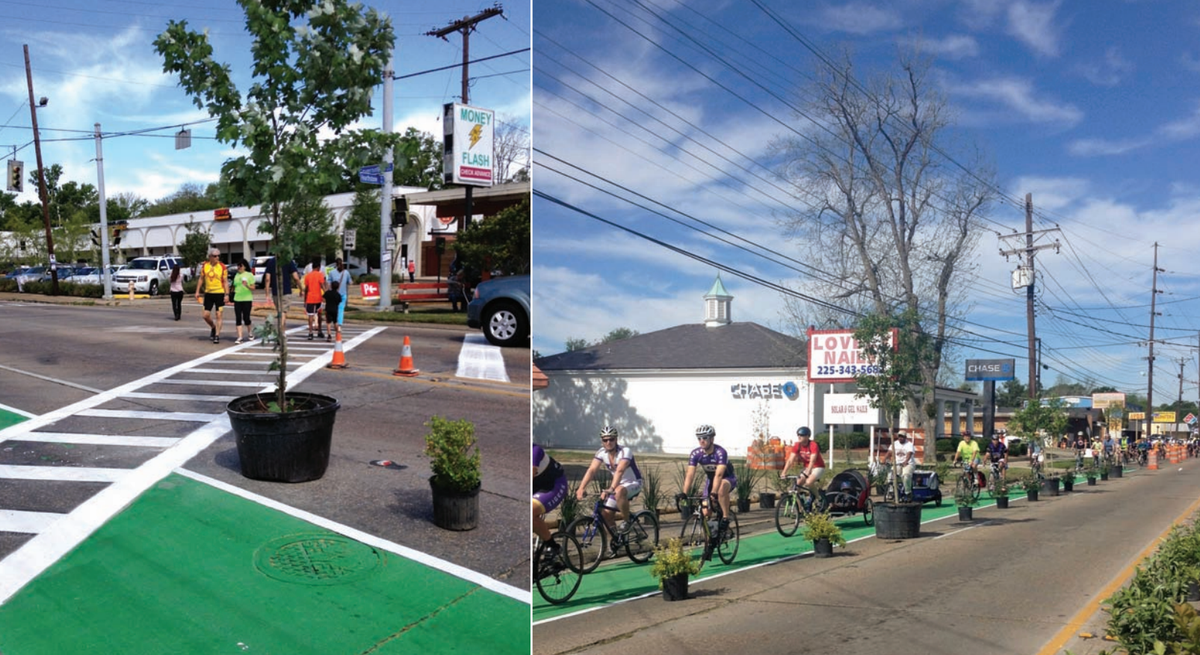
Government Street’s road diet was once easy prey for NIMBY complaints. Now, after the results, most of the grumbling has gone quiet.
Why it matters: Converting Government from four lanes to three, with bike lanes alongside, created a safer corridor with more retailers. It also gave Mid City a more real identity as a place.
The catch: The work is not finished. Planners, developers, property owners and civic leaders say the next phase is about steady improvements that build on the momentum already there, plus one catalytic project.
How we got here: Government used to be a fast, uncomfortable road. The Center for Planning Excellence helped change the conversation with a pop-up demonstration showing that Government could work better for drivers, cyclists and pedestrians. Then-Mayor Kip Holden backed the redesign, and the Louisiana Department of Transportation carried it out.
What happened next: The results backed up the idea. Two years after the road diet, sales tax growth along Government was 26% higher than the citywide rate, per a study by the Greater Baton Rouge Economic Partnership, then BRAC. Monthly traffic incidents were cut in half, even as the corridor attracted more activity.
That helped turn Government into more than a pass-through. A friend of RedEye noted last week that older residents knew the area by individual neighborhoods. Younger people are more likely to call it Mid City. That is what happens when a corridor becomes a destination.
What is still in the way: Developers and commercial real estate agents say absent landlords are slowing progress, while some want too much for idle properties. Some property owners add that neglected buildings help feed blight and, in some areas, crime.
Another tension is the cost of doing new development the right way. New mixed-use projects on Government face stricter urban design rules, such as requiring buildings to be brought closer to the street to create a stronger streetscape. That raises costs. But it also creates the kind of corridor that attracts customers.
The big picture: The next step is to keep improving Government to draw more people, strengthen neighborhoods and cement Mid City as one of the parish’s most interesting places.
Below are ideas from people in the know.
• Justin Lemoine—the landscape architect who created Mid City Makers Market and led the installation of the sculpture next to Baton Rouge Magnet High School, sees several practical moves.
- Streetscape improvements could help make Mid City feel more like Baton Rouge’s arts district. That could include more sculptures along Government. Lemoine’s group also wants Mid City flags on utility poles to give the corridor a unifying visual identity.
- Medians on Government need another look. They have slipped into disrepair because the original plantings were hard to maintain and the irrigation system failed. Lemoine says native plants would survive without expensive upkeep. He is working with a group to pull that off.
- Storefronts need to catch up to the new Government Street. Many of those frontages were designed for the old four-lane road, not the calmer corridor that exists today. Lemoine recommends parish design grants to spur property owners to reshape those spaces so they fit the street Government has become.
- One big project is needed: a catalytic redevelopment on the former eight-acre state-owned site next to Albertsons. Lemoine's idea is to land a developer such as Mike Wampold to build a boutique hotel and related retail. The property is for sale.
• Camille Manning-Broome–The EO of CPEX says safety for cyclists, landscaping upgrades and rewriting the city code should be next.
- Dropping speeds from 45 to 35 mph was a good start. Getting to 30 mph or below would make the street feel safer. To separate cyclists, a few proven solutions: buffered lanes with painted space between bikes and cars, flex posts that create a low-cost barrier, and, where possible, curb-protected lanes with a real physical divide.
- Plant street trees in existing wells and create landscaped buffers for physical and psychological separation, helping to calm traffic, reduce speeds and create a more inviting public realm.
- Audit and rewrite code and policy to encourage walkable, mixed-use development. Changes include modernizing parking requirements, encouraging infill and aligning land use with the vision for a people-centered corridor.
• Whitney Hoffman-Sayal—the ED of the Downtown Development District says more housing along the corridor should be a priority, along with reworking Government in downtown.
- More residents mean more eyes on the street, which can help reduce crime and strengthen the urban fabric between downtown and Mid City. She says tools such as new construction tax abatements could help make that happen.
- The Government Street makeover essentially stops at Interstate 110. West of the highway, downtown still has a four-lane version of Government. Hoffman-Sayal says that the stretch, especially given future River Center plans, should eventually be remade into something more walkable and bike-friendly, extending all the way to the river.
- Policy changes that speed improvements would help. To that end, Madison, Wisconsin, offers a useful example. The city has embraced incrementalism, trying low-cost ideas before making larger commitments. And that's exactly how the transformation of Government happened, with a low-cost pop-up that let people dream what the road could become.
Bottom line: Government Street’s road diet was not the end of the story. It was the first chapter. The next gains will come from a series of moves that make Mid City greener, denser, more attractive and more clearly itself.