
Taxed, or just frustrated
Baton Rouge voters spent decades building the tax system they now curse.

Complaining about taxes is practically a civic sport in East Baton Rouge Parish. It's not just the amount of taxes, but where the money does—and doesn't—go, and what taxpayers believe they're getting in return.
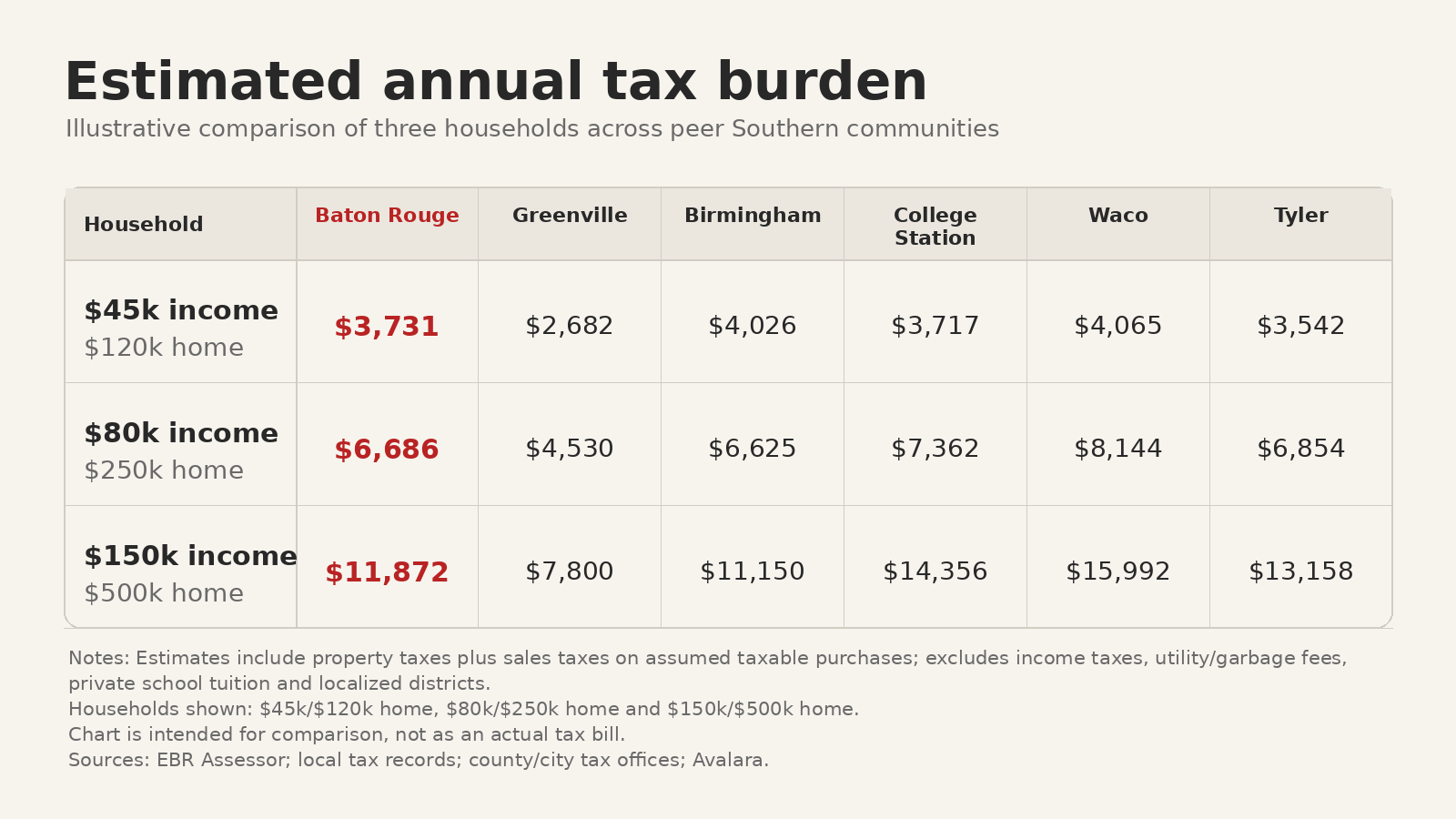
Here's the reality check: Preliminary comparisons suggest residents are not paying substantially more in local taxes—less in some cases—than taxpayers in several comparable Southern communities.
Why it matters: Every new tax pitch or renewal ignites a new round of complaints about tax rates, high crime, bad roads and mediocre government services. But if taxes here aren't dramatically higher than in peer cities, the frustration runs deeper than how much residents pay.
By the numbers: Baton Rouge falls somewhere in the middle—according to a RedEye comparison of three illustrative households in six Southern communities—more expensive than Greenville, South Carolina, but typically less expensive than the Texas cities of College Station, Waco and Tyler.
A byzantine system: The parishwide tax structure didn't materialize overnight. Residents have spent decades creating independent taxing authorities and approving dedicated taxes earmarked for specific purposes, rather than discretionary spending.
- State law created EBR public schools, BREC and the sheriff's department.
- CATS is a voter-approved independent taxing authority, though it isn't actually parishwide.
- The library system and Mosquito Abatement and Rodent Control (MARQ) technically aren't independent taxing authorities, but effectively operate as one.
- The Council on Aging-Baton Rouge isn't a government agency, but voters have given the nonprofit dedicated taxing ability.
Wait … what? You should be confused.
Taxing matters: It's not just who's doing the taxing; voters also obsess over the type of tax and who pays it.
- Property taxes, with one of the nation's more generous homestead exemptions, are lower than in other cities, but stir the most controversy. It's the one local tax where an annual all-in bill arrives in the December mail, nestled among the holiday cards, so do the math.
- Sales taxes are regressive, but the tax of choice. Voters like that everyone pays, explaining why EBR has one of the nation's highest sales-tax rates. Embedded in almost every purchase, one wonders whether anyone actually knows their sales tax bill over the course of a year.
- The maze of independent taxing authorities and dedicated taxes looks good on paper. The reality is these agencies accumulate significant dollars that can't legally be redirected, leaving the city-parish government to deal with the basics of government services while juggling oversized retirement and benefits obligations.
- The result is that some government agencies provide premium or award-winning services, while the city-parish is struggling to fund road repairs, stormwater management, grass cutting and other basic government services.
Suburban shift: The rise of incorporated cities, especially the geographically large and sales-tax-rich St. George, means sales tax dollars that once flowed to city-parish government now remain within the suburban municipalities. The parishwide taxing agencies still collect their property taxes.
Reversal of fortune: Complaints aren't new, but the rejection of two recent proposals suggests voters are pushing back.
- Mayor Sid Edwards' Thrive proposal was soundly rejected last year, though poorly executed planning and messaging didn't help.
- More shocking was voters' rejection of a dedicated property tax for the District Attorney's office and popular DA Hillar Moore.
- Organized opposition is spending big money against the library tax renewal on June 27.
A taxing fee: Property owners also pay water, sewer and garbage fees—families who choose private school tuition often see it as an added cost-of-living burden.
The bottom line: Baton Rouge's tax fatigue appears less about paying dramatically more than people elsewhere and more about navigating a complicated system that often leaves taxpayers unsure whether they're getting their money's worth. The irony is that it's a system voters have spent decades building—one dedicated tax, one independent taxing agency and one incorporated city at a time.