Nobody asked permission
How Baton Rouge's most effective civic improvements actually happen—and why they don't happen more often.
The Perkins Road Overpass District has been one of Baton Rouge's most successful neighborhood commercial corridors for years. Restaurants, bars, retail—all of it built organically, without a master plan or a government catalyst. People just started doing things.
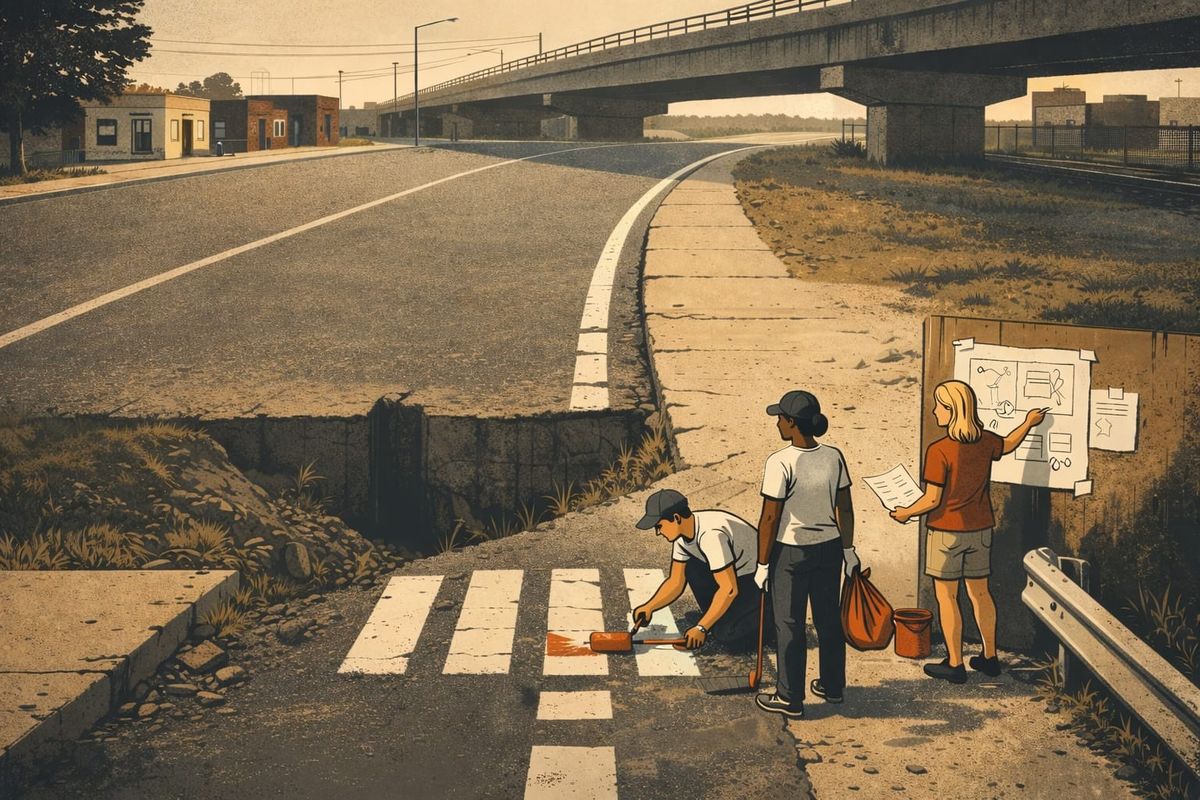
And yet, for most of that time, residents in the Garden District, Poets and Hundred Oaks couldn't safely walk there. A narrow two-lane bridge over a railroad track—dangerous on foot, worse on a bike—sat between them and one of the city's best blocks.
Nobody in government moved to fix it.
So Jenni Peters, Misti and Brumby Broussard and other business owners did. They personally funded a design to route pedestrians and cyclists safely underneath the overpass through the railroad right-of-way—bypassing the bridge entirely. They pushed it forward. The parish eventually joined. A railroad agreement followed. A $3 million connection is finally moving toward construction.
Urban theorist Kevin Klinkenberg has a name for that instinct. He calls it the Messy City.
Why it matters: Baton Rouge has spent decades chasing large-scale solutions—master plans, major development projects, infrastructure overhauls, regional economic strategies. Some of those investments matter. But the Messy City idea points to a different and more fundamental truth about how cities actually improve:
- Change rarely starts with institutions. It starts with people close enough to a problem to see it and motivated enough to do something about it.
- Small bets, repeated, compound into something real.
- The most important actors in a city aren't always the biggest ones.
Not just theory: Baton Rouge has those people.
- Marie Constantin organized volunteers to pull dozens of garbage bags of trash from Capitol Lakes—month after month—before years of advocacy finally forced a systemic response.
- Jennifer Richardson didn't wait for a public works crew—she launched weekly cleanups across the city, attracted corporate support along the way, and toiled for years before government stepped in to help.
- These aren't feel-good volunteer stories. They're evidence of something more pointed: when formal systems underperform, informal ones emerge—and the people filling the gap rarely get a quick assist.
The Big Picture: None of it is easy. The path from citizen initiative to institutional response in Baton Rouge is rarely short and never guaranteed.
- Peters and the Broussards had to fund the design themselves to get the parish's attention.
- Constantin's advocacy stretched over years.
- Richardson and her volunteers toiled long before any government help arrived.
- The frustration is real—and it stops some people before they start.
Reality bites: Local conditions make it harder still.
- Independent taxing authorities focused on specific functions struggle to address problems that span jurisdictions.
- A voter culture that prefers dedicated over discretionary spending produces a system optimized for predefined services—and less capable of responding to emergent ones.
- Fragmentation across a metropolitan area diffuses the energy that enables response.
The current system, at best, is OK at executing what it planned. It struggles with what it didn't.
A hybrid mess: Not every local example is purely bottom-up. The Government Street road diet and the broader Perkins Road Overpass District both reflect a variation—citizen energy and advocacy organized through the Center for Planning Excellence (CPEX), pushing until government moved. The instinct was the same. The path was more structured. Both work. The point is that change originated outside City Hall, not inside it.
The Bottom Line: Peters, the Broussards, Constantin, Richardson—none of them asked for permission. None of them had an easy path. The question their example makes unavoidable is why it doesn't happen more often. Not because the answer is complicated. Because it isn't.