Lori Melancon's plainspeak
The head of the region's economic development engine goes public, saying what's usually reserved for private conversations.
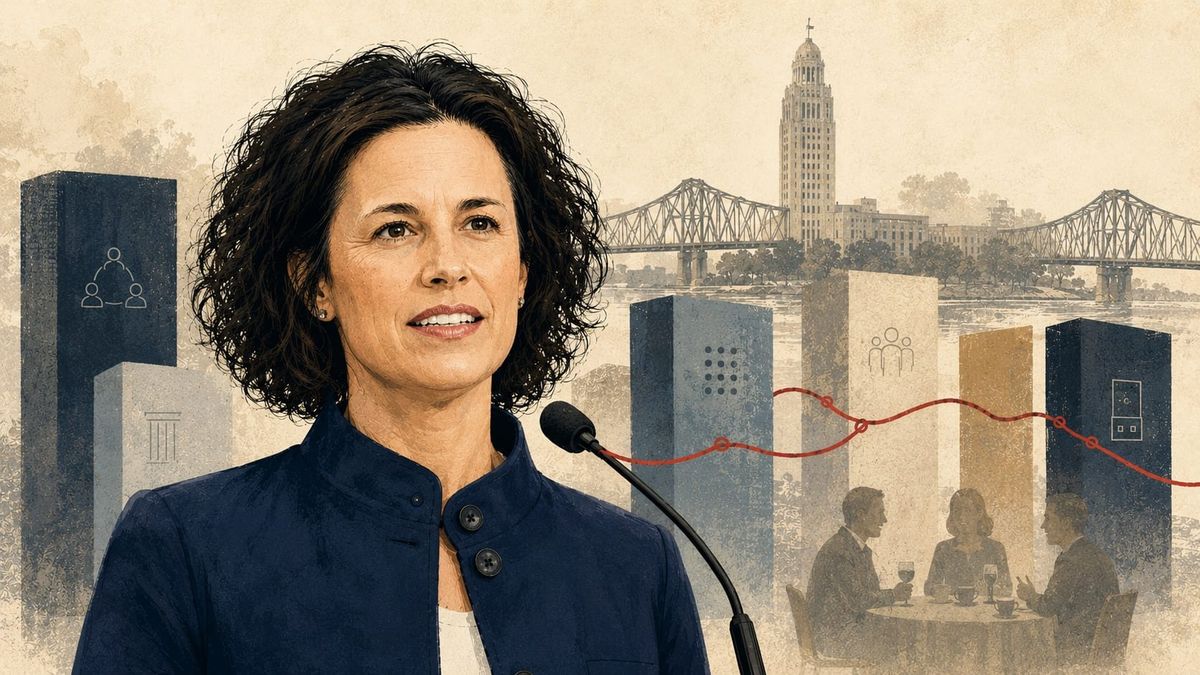
Lori Melancon has spent the past two years selling Greater Baton Rouge to the world. Monday night, she spent a few minutes telling Baton Rouge the truth about itself.
Why it matters: Public figures in Baton Rouge rarely say the hard thing out loud, particularly when those hard things implicate the civic culture they help lead. Melancon did it anyway—and named the specific habits standing between EBR and meaningful progress on its No. 1 problem.
Going public: Melancon, president and CEO of the Greater Baton Rouge Economic Partnership, was one of three panelists at the Baton Rouge Area Foundation's sixth Opportunity Data Project briefing—a public presentation built around new data showing 45% of EBR families with children are poor or near-poor.
- Melancon's words and the passion with which she said them are typically reserved for private lunches, post-work cocktails, and early-morning coffee confabs, not public consumption.
The diagnosis: Melancon didn't hesitate when asked what Baton Rouge needs to stop doing. The answer wasn't a program gap or a funding shortfall. It was behavioral.
- Baton Rouge, she said, operates in silos—organizations, agencies and funders each protecting their own turf rather than functioning as a coordinated system. The problem isn't a lack of good work. It's that the good work doesn't connect.
- She hammered away at the community for having "a very low appetite for friction." The city is so committed to keeping the peace—to seeing one another at church on Sunday and at the cocktail party on Friday—that it consistently avoids the hard conversations required to actually change anything.
- The result is a civic culture that talks about problems in careful, collegial terms while the underlying conditions get worse.
- The data backs her up. EBR's poverty rate has climbed from 18% to 25% over the last decade. The parish ranks in the bottom 10 nationally among comparable metro areas for combined poverty and near-poverty rates. Those numbers didn't happen in a vacuum. They happened while Baton Rouge was being polite.
The ask: When BRAF's Chris Meyer asked what it would mean for Baton Rouge if every family moved up one rung on the economic ladder, an emotional Melancon answered without hedging.
- "That means there's no third grader struggling to keep their eyes open because they're hungry because they haven't had dinner the night before. It means that the grandma who's afraid to walk to her mailbox because there's gunshots on her street can go get her mail in peace. It means that every single high school student is finishing high school or has a shot to do it, and is fully participating in their own future."
- She closed with what everyone in that room already knew: "We have got to get out of our own way."
The Bottom Line: Melancon didn't break any news Monday night. She just went public with it—and in Baton Rouge, that alone is worth noting.

Baton Rouge is not going to fix itself. It might, however, be better understood.
That is where RedEye comes in. We cover this parish with original reporting, sharp analysis and an interest in solutions rather than slogans.
If our journalism has helped you make more sense of Baton Rouge, please upgrade to a paid tier.