
Commentary: The compromise that wasn't
The golf course stays. The question is what—and who—gets left out.
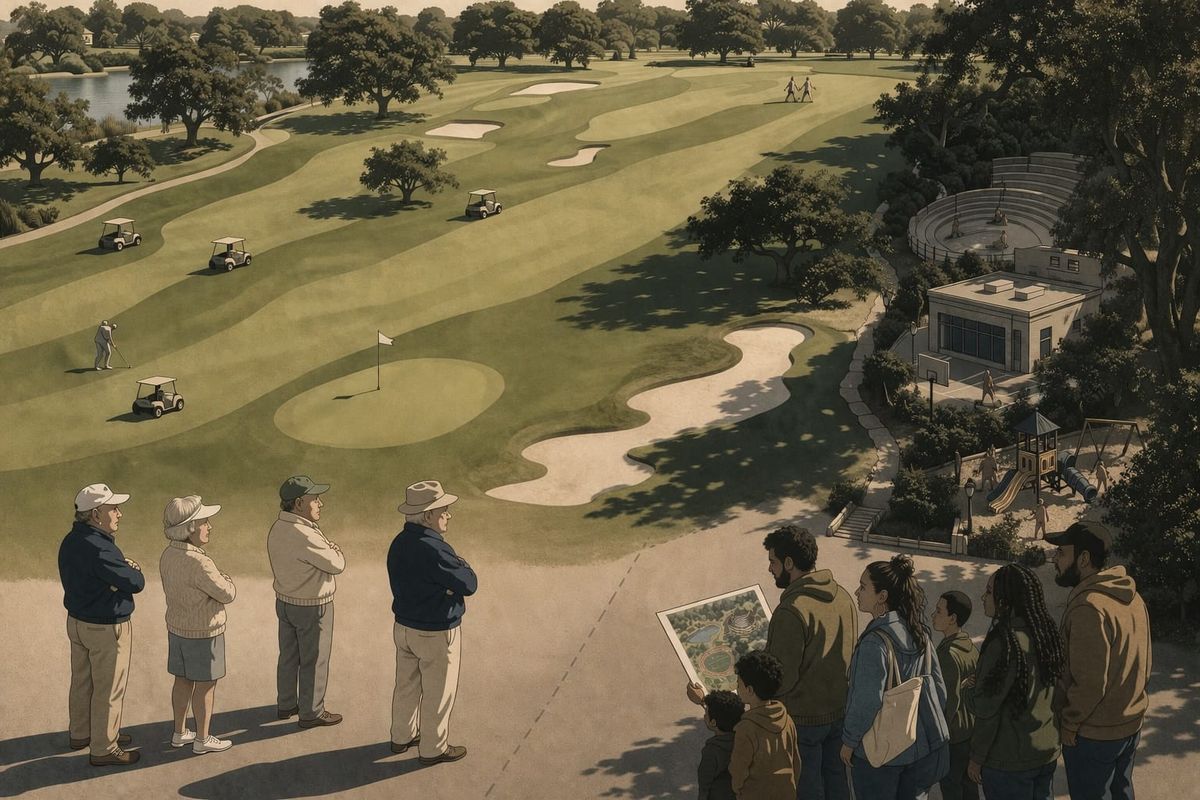
Monday night's City-Brooks Park stakeholder meeting ended the way Baton Rouge civic processes usually end—with everyone unhappy and nothing resolved.
That's not entirely fair. One group got what it wanted.
What happened: Sasaki unveiled two concept options for the 154-acre park to about 30 invited stakeholders at the Knock Knock Children's Museum. Both preserve the golf course. Both distribute everything else across what's left—Brooks Park, the narrow rolling corridor between Brooks and Dalrymple Drive, and a lakefront edge loosely connected to the University Lakes renovation.
Why it matters: Two groups arrived with completely different mental models.
- Young park advocates had already accepted that golf wasn't going anywhere. They expected something meaningful in return.
- The golf constituency regarded Sasaki's presentation as an opening bid.
- By the end of the night, one side had extracted a concession. It wasn't the young advocates.
The tell: Sasaki's Josh Brooks signaled that mini golf—one of the few amenities specifically designed to broaden the park's demographic reach—might not survive. His evidence: a Mentimeter poll of 28 people who skewed older, whiter and more pro-golf than Baton Rouge's actual population. Many couldn't get the technology to work.
Sasaki's own public survey showed that its 1,084 respondents were 85% white and 43% earned over $150,000—and a second survey was launched to broaden its reach. That survey is still technically open. Does it really matter? Monday night's room carried more weight than all of them.
For a master planning process with a $600,000 price tag, one might expect a scientific survey—one designed to capture the full community—to be the baseline.
Not one more inch: The young advocates' stance has hardened. They see a plan that protects the most prominent, most beautiful terrain in the park—a 2,300-yard, 9-hole municipal course its defenders discuss as though it were our Augusta National—while cramming every "make everyone happy" amenity into what's left.
Ashlé Young, a young leader, mother and wife from North Baton Rouge, framed the dynamic plainly: Baton Rouge will tell Black communities their park is closing and the next one is two miles away. It will not ask golfers to drive a mile to Webb Park.
Not that Webb Park is an option, say Save Our Park advocates. They argue "Webble Beach"—as the course is known among regulars—is already at capacity and couldn't absorb the influx should City Park be dramatically altered. Every door, in their view, is closed. Every compromise, a threat.
Forced perspective: The renderings look ambitious. A rec center. A 400-meter public track. An amphitheater. A botanical experience. A braided bayou. A skate park. An oak canopy walk. A lakefront promenade.
The available footprint, once golf is protected, is much smaller than any of that suggests. Something gets lost in translation from rendering to reality. Privately, people on both sides of the golf debate have questioned whether the designs are actually feasible as presented.
The young advocates who compromised aren't just getting less than they hoped. They may be getting less than they've been shown.
The wild card: The course is one of about 25 remaining Tom Bendelow signature municipal designs in the country—a fact that became key to preservation debates roughly 20 years ago when serious suggestions first emerged about reimagining the property.
Convenient timing aside, Sasaki hasn't asked the accrediting organization whether its proposed alterations would cost the course that status. For a deal this big—and a decision so important—that's a notable oversight.
The bigger picture: This isn't happening in isolation. Baton Rouge has more community-defining projects in motion than it has seen in decades.
- The $79 million University Lakes restoration is on track to finish dredging by year's end.
- A $400 million LSU arena is moving toward reality on the Nicholson corridor, anchoring an emerging entertainment district its backers describe as transformative.
- Plan Baton Rouge III—the first update to the city's downtown master plan since 2009, also led by Sasaki—is expected to be unveiled shortly. Those who've had an early look have one word for it: underwhelming.
The conservancy question: Lost in Monday night's back-and-forth was perhaps the most consequential item on Sasaki's agenda. Brooks confirmed the firm's scope includes assessing whether a 501(c)(3) nonprofit conservancy model—rather than continued BREC management—would better serve City-Brooks Park's future. A recommendation is expected within two months.
No matter what one thinks of the current options, sustainable execution of any master plan likely requires exactly that kind of model. BREC, whatever its merits, has proven susceptible to organized political pressure. The golf constituency knows this. They have repeatedly and effectively demonstrated how to work that dynamic.
A conservancy board operates differently. The playbook that has worked so well inside BREC's structure may not translate. That alone may explain why the conservancy question, raised quietly near the end of the meeting, generated so little enthusiasm from certain corners of the room.
The promise: BREC Commission chairman Mike Polito framed this entire process around a single idea. "City Park needs to be what the next generations want it to be," he told RedEye last month.
Those next generations have shown up for this process, though few were invited Monday night. They compromised. They spoke. Now they're holding the line.
The bottom line: For more than a generation, Baton Rouge leaders have preached the importance of making this community a more desirable place for young people to live, work and play. When those young people finally pull up a chair, the room has a way of filling up with other people's priorities.
Is anyone listening?
—JR Ball