
Baton Rouge's plan. Does it deliver?
RedEye analyses the mayor's unreleased strategic plan. What it says—and what it doesn't
A 10-year strategic plan obtained by RedEye lays out the most comprehensive diagnosis of what's broken in Baton Rouge. The plan, costing $250,000, has not been formally released to the public by Mayor Sid Edwards administration.
Here's what it says—and what it doesn't.
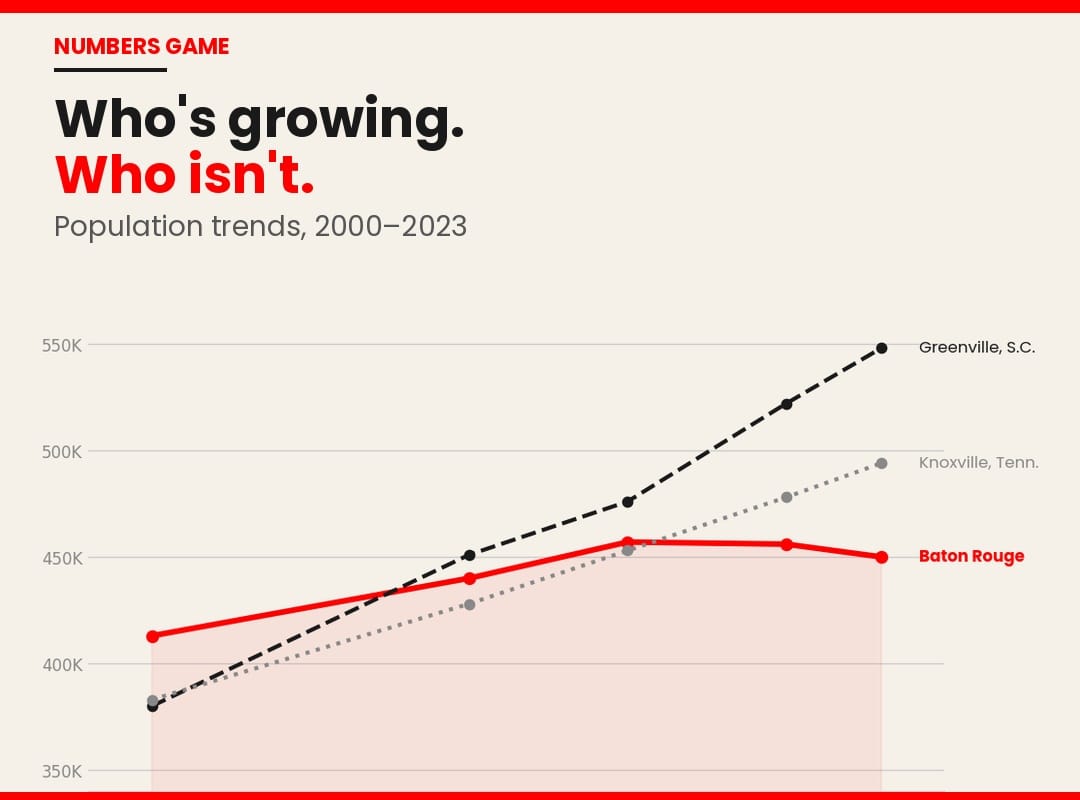
The hard numbers: The plan documents a city in measurable decline. Baton Rouge's population has plateaued and begun to fall while peer cities like Greenville, S.C., and Knoxville, Tenn., continue to grow. Housing affordability has dropped every year since 2014. A possible budget deficit—exacerbated by the St. George incorporation, according to the document—looms by fiscal year 2027.
On crime: The plan's most developed section identifies a "5% Rule"—a small number of geographic locations account for a disproportionate share of shootings—as the framework for targeting resources. It documents BRPD operating 130 officers below its authorized strength of 696, with non-competitive pay the primary barrier to recruitment. Edwards' recently announced historic police pay raise addresses that directly.
Sources also tell RedEye that the administration is exploring a reformulated version of the BRAVE violence-reduction program, potentially in partnership with DA Hillar Moore, to address the prevention side of the equation.
On blight: The plan calls for aggressive blight removal and code enforcement, but offers no specific targets, timelines or funding mechanisms. Meanwhile, a governance standoff between the administration, the Metro Council and the Greater Baton Rouge Economic Partnership (formerly BRAC) over who controls the condemnation process remains unresolved—even as Build Baton Rouge has operated the region's only land bank, with legal authority to acquire and redevelop blighted properties, for years.
On brain drain: The plan is blunt. Baton Rouge is losing the population competition to comparable Southern cities, and net migration—whether people choose to stay or leave—is the single metric that cuts across all five of the plan's strategic pillars. Young people, the plan argues, will stay if safety improves, neighborhoods stabilize and economic opportunity expands. That's probably true. What the plan doesn't fully answer is how to make it happen fast enough to matter.
On economic diversification: The diagnosis is accurate—Baton Rouge remains too dependent on petrochemicals and state government, while peer cities build advanced manufacturing, research and technology bases. The proposed solutions—workforce development, university partnerships, corridor revitalization—are directionally correct but read more like aspirations than a strategy.
On quality of life: The plan envisions walkable districts, vibrant cultural amenities and thriving parks by 2035. The specifics of how to get there are largely absent.
On poverty: The plan doesn't address it. For a city that ranks 182nd out of 250 on the Geography of Prosperity Index, that omission is difficult to ignore.
On governance: The plan devotes considerable attention to recommending the adoption of a professional city manager model—a structural reform that would require a vote of the residents. Edwards has not pursued that path. Instead, he hired Christel Slaughter—whose SSA Consultants firm authored the strategic plan—as his top administrative advisor on a contract basis.
The bottom line: Edwards says it plainly in his letter accompanying the plan: "This plan is not simply a document—it is a commitment to action." He's right about that. The plan's value isn't in its pages—it's in whether the hard work of execution follows. On crime, there are early signs of movement. On blight, economic diversification, brain drain and poverty, the work is largely still ahead.