Commentary: Children are dying
This is not a crime spike. This is a city that has never honestly confronted why this keeps happening.
Three incidents. Four days. Two dead children.
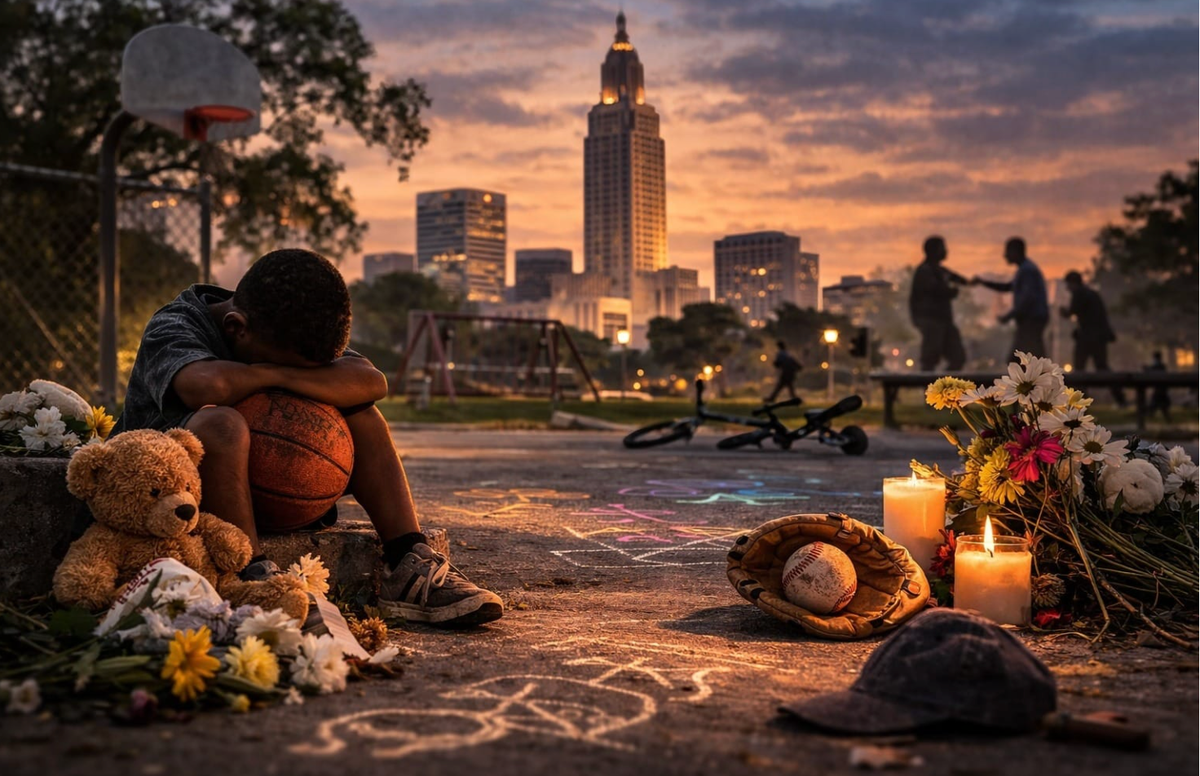
Eight-year-old Davian Nicholas was playing basketball with friends on San Juan Drive on Sunday when a shootout between two groups erupted nearby. He was struck in his own front yard and died at the hospital. Tuesday afternoon, a 10-year-old girl was killed in a Sonic parking lot on Government Street, shot by her younger sister who was playing with a gun. In between, a shooting near BREC's Hartley/Vey Park sent Little League players and coaches sprinting off the field in every direction.
This is not a crime spike. This is a city that has never honestly confronted why this keeps happening.
Why it matters: The response from Baton Rouge's political class will be familiar: more police, longer sentences. It's the same conversation the city has every time. Louisiana already leads the nation in incarceration rate. More of the same has not bent the curve—because it doesn't address what produces violence in the first place.
What's actually happening: Baton Rouge's violence isn't random. It incubates in specific geographies where conditions compound across generations:
- Concentrated poverty and chronic unemployment leave young men with no credible path to income or identity through legitimate means. Other economies fill that void—with their own enforcement norms.
- Children raised inside persistent violence absorb it as the operating reality. Untreated trauma produces the short-horizon thinking that makes the next shooting more likely, not less.
- Institutional neglect—underfunded schools, absent behavioral health infrastructure, gutted community organizations—removes the forces that interrupt cycles before they harden.
The harder conversation: There's something Baton Rouge rarely says out loud. Mass incarceration stripped economic anchors from specific neighborhoods at scale. That damage is real. But structural failure isn't the only failure.
In homes across Baton Rouge, there are children growing up without adult presence, without supervision, without anyone modeling that another person's life has value. Not every absence can be explained by policy. Some are personal decisions.
Violence compounds where accountability erodes—in institutions and in homes.
This is not a racial indictment. It's a civic one. A city where too many adults—at every level—stopped demanding responsibility from themselves and from each other.
All of us own a piece of that.
What actually works: The one serious attempt at community-based intervention here—the Safe, Hopeful, Healthy BR initiative—collapsed under mismanagement and federal investigation. That failure handed politicians an easy excuse to retreat to law enforcement solutions. It shouldn't. Cities that have moved the needle on entrenched violence did it with:
- Focused deterrence programs targeting the small number of people most likely to shoot or be shot.
- Behavioral health infrastructure that treats trauma as the public health crisis it is.
- Targeted economic investment in the specific zip codes where violence concentrates.
Ironically, Mayor Edwards has pointed to Detroit as a model for what Baton Rouge could become. Detroit's turnaround wasn't built on incarceration. It was built on exactly this kind of structural investment.
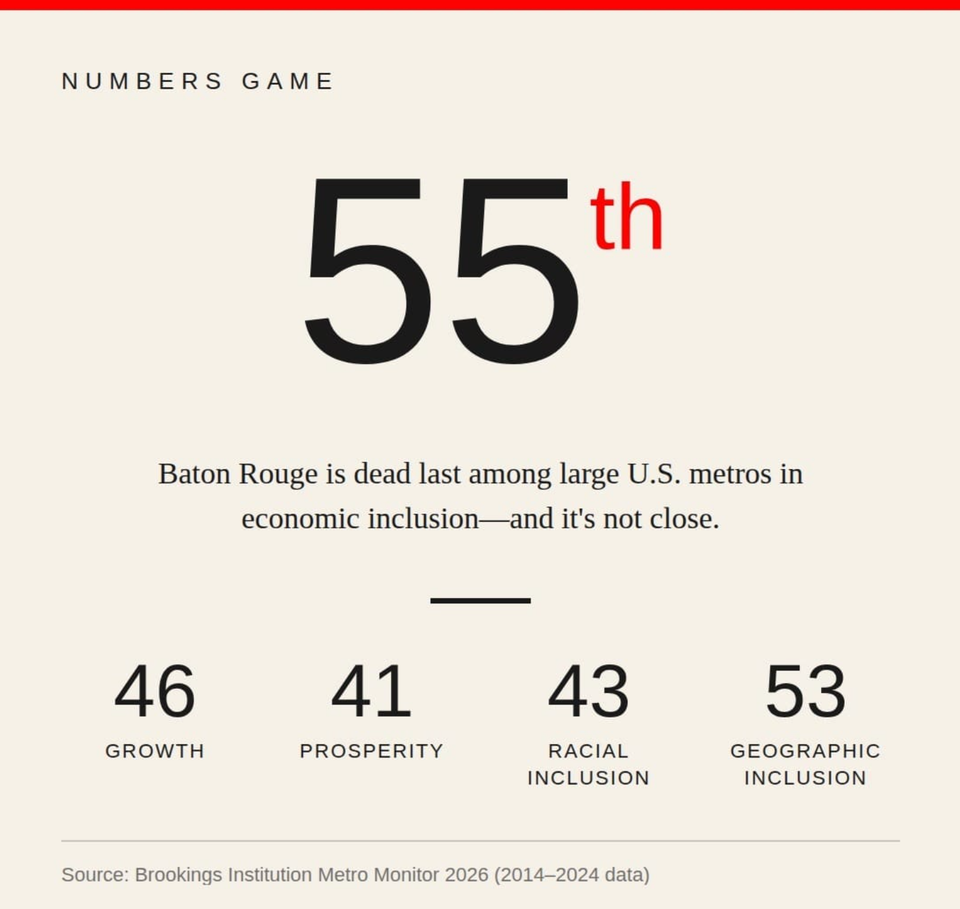
The bottom line: That sustained failure carries a compounding cost—in stunted development deals, in talent that chose another city, in a civic narrative that can't escape its own headlines. Baton Rouge cannot arrest its way to becoming a city worth staying in.
Davian Nicholas was 8 years old. He was playing basketball. This city owed him more than what it's been doing.