
Baton Rouge has a prosperity problem
A national index puts the parish in the bottom third for a sustainable economy
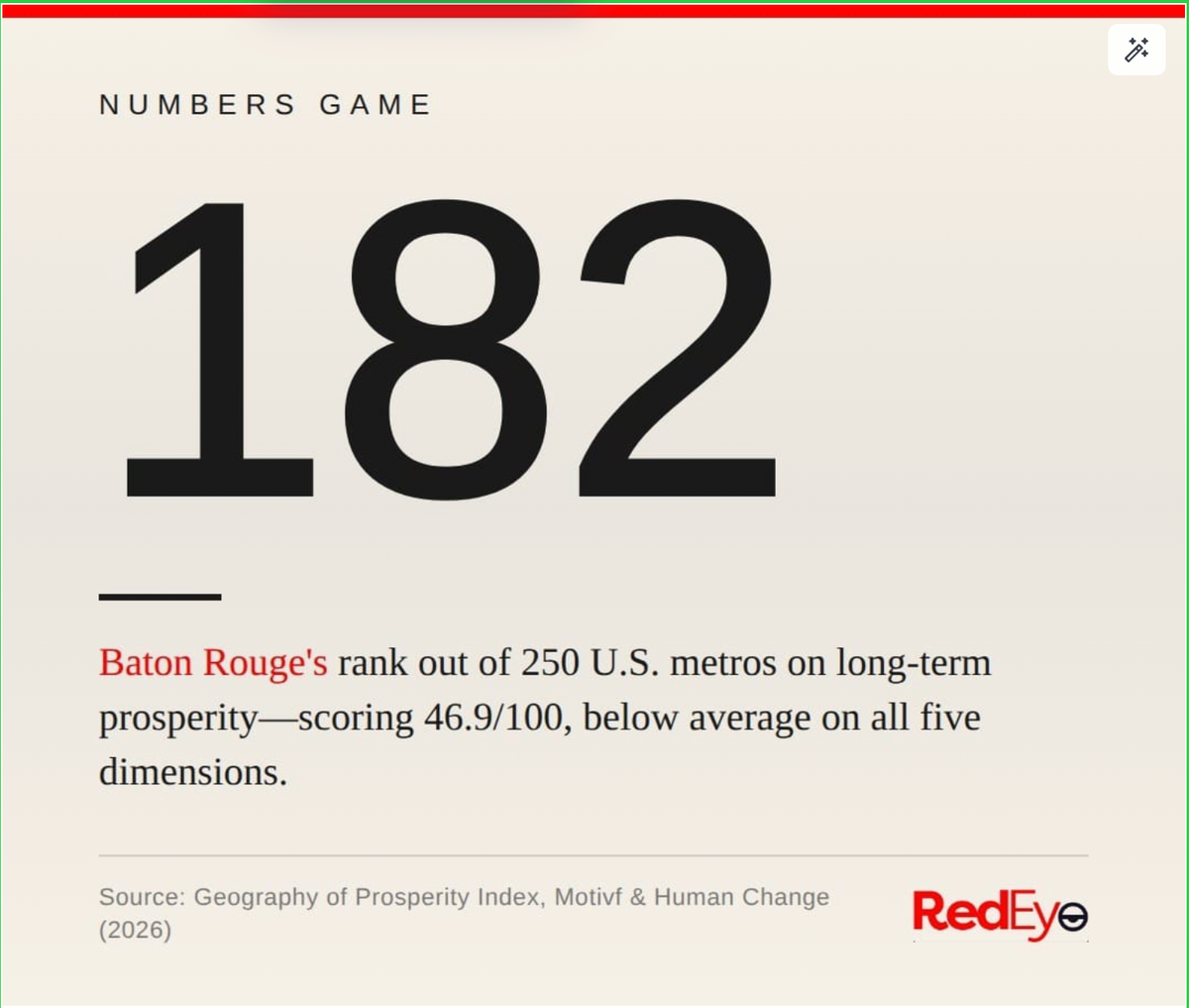
Baton Rouge scored 46.9 out of 100 on a new national index measuring whether cities are structurally built to sustain prosperity over the coming decades—landing 182nd out of 250, well into the bottom third. Every dimension lands below the national average. The weakest is Governance & Foresight at 39.4/100—the primary drag on the composite and the most honest diagnosis of why the city's other challenges persist.
Why it matters: The index goes beyond capital investment, announced projects and job growth, and asks a harder question: Is Baton Rouge building the systems that will sustain prosperity when the next flood hits, when automation reshapes the industrial workforce, and when the next generation of talent decides whether to stay?
- Baton Rouge's best dimension, Climate Resilience at 60.7/100, still ranks 198th nationally.
- Governance & Foresight at 39.4/100 is the primary drag on the composite.
- The index's creators found governance is the single most consistent indicator of whether metros absorb shocks or are destabilized by them.
Bit of background: The Geography of Prosperity Index, developed by research firms Motivf and Human Change, evaluates 250 U.S. metro areas across five systems: climate resilience, automation readiness, population renewal, social cohesion and governance and foresight. It doesn't measure how a city is doing today. It measures whether a city is building the systems required to stay competitive—for talent, investment and economic diversification—over the next generation.
The root problem: Economic diversification has been a stated priority in Baton Rouge for two decades. The reason it hasn't happened isn't a lack of ambition—it's the absence of the institutional machinery to execute it. Those are governance functions. Baton Rouge has struggled to sustain them across administrations.
The talent picture: The index found social cohesion is one of the strongest predictors of whether mobile talent stays or leaves.
- LSU and Southern produce real talent. The region continues to export most of it to Houston, Atlanta and Austin.
- Persistent segregation, sprawl and underinvestment in public amenities are structural conditions shaping whether young professionals with options decide Baton Rouge is worth staying in.
- The capital region loses young professionals faster than it replaces them.
The investment case: Sophisticated site selectors are beginning to use forward-looking frameworks like this one. A composite score of 46.9 will appear in those conversations. A city with strong output today but weak governance and a shrinking talent pipeline is a different investment environment than its growth numbers suggest.
The bottom line: The index didn't create Baton Rouge's structural challenges. It gave them a national number.
Deep dive: Explore Baton Rouge's full profile at geographyofprosperity.com. The Harvard Business Review analysis is here.