BR Dead last. A decade of proof.
Where a city ranks on growth, prosperity, and inclusion determines whether its residents can find good jobs, build wealth and access opportunity.
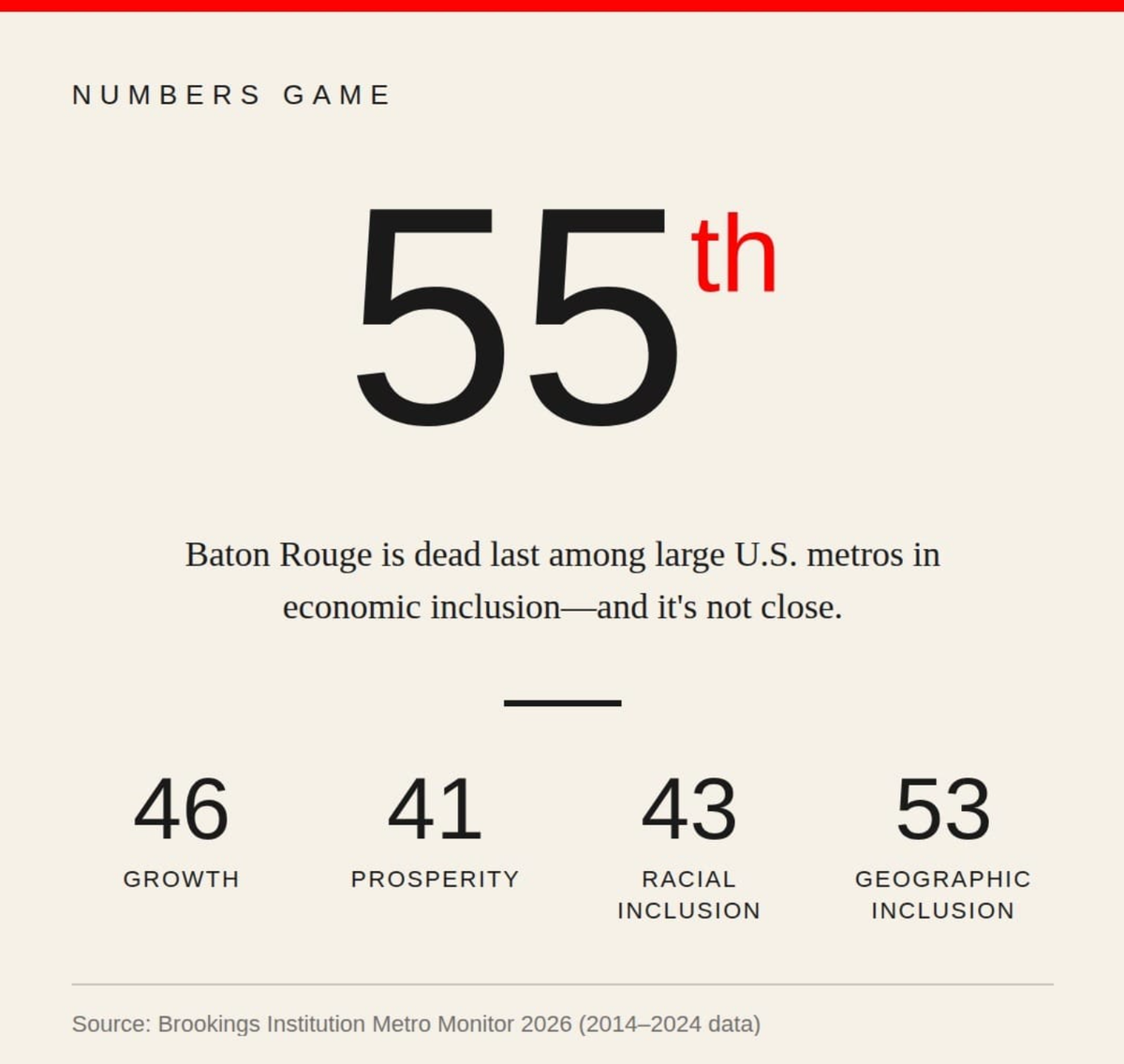
Baton Rouge ranks dead last among its peer cities in economic inclusion—and near the bottom in growth and prosperity—according to a decade of new federal data analyzed by the Brookings Institution.
The Metro Monitor 2026 tracks 15 economic indicators across 196 metro areas from 2014 to 2024. Among 55 large metros with populations between 500,000 and 1 million, Baton Rouge ranked 46th in growth, 41st in prosperity, and 55th—last—in overall economic inclusion.
Why it matters: Where a city ranks on growth, prosperity, and inclusion determines whether its residents can find good jobs, build wealth and access opportunity. For Baton Rouge, a decade of bottom-tier finishes is also a direct headwind to economic development efforts, diversification away from petrochemicals and the region's long struggle to attract and retain young professionals.
What it means: A decade of data rules out bad luck. This is structural.
- The city's employment rate grew by just 1.0 percentage point over 10 years, last place among comparable American cities.
- Poverty got worse, not better, up 0.7 points over the same period.
- The gap between Baton Rouge's wealthiest and poorest neighborhoods widened faster than in nearly every peer city—53rd in geographic inclusion and dead last in neighborhood employment gaps.
- The racial employment gap between white residents and people of color widened 3.3 points, ranking 53rd.
- The one bright spot: median earnings rose 23.8%, a top-half finish. But rising wages while employment stagnates and poverty spreads tell you exactly who's getting ahead.
The cities consistently outperforming Baton Rouge—Raleigh, Charlotte, Nashville—share a common profile: diversified economies, growing immigrant workforces, and sustained investment in knowledge industries. Brookings found that metros with the largest increases in foreign-born workers saw the strongest job and wage growth over the decade. Baton Rouge's foreign-born population sits at roughly 5%—well below the national average for large metros.
The bottom line: The report doesn't describe a city going through a rough patch. It describes a city that has been losing ground, measurably and consistently, for 10 years.
(See the data. Read the full report.)