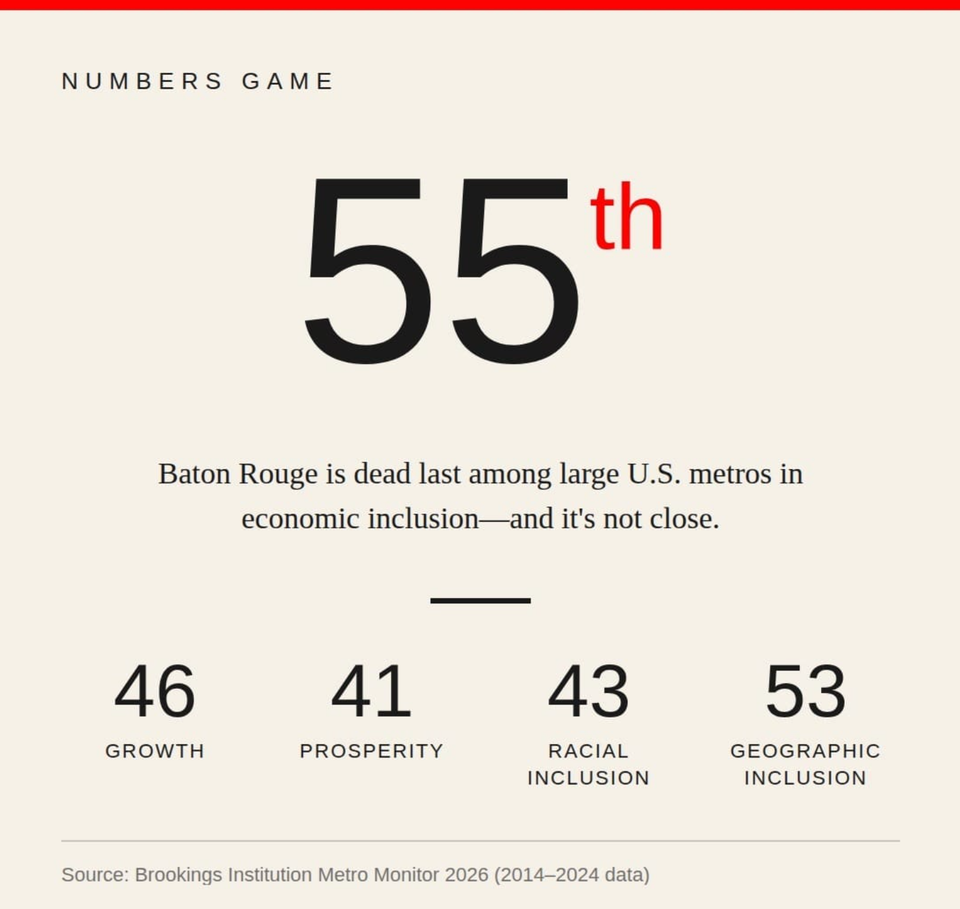
An election where nobody came
What to do about ballots that draw very few voters
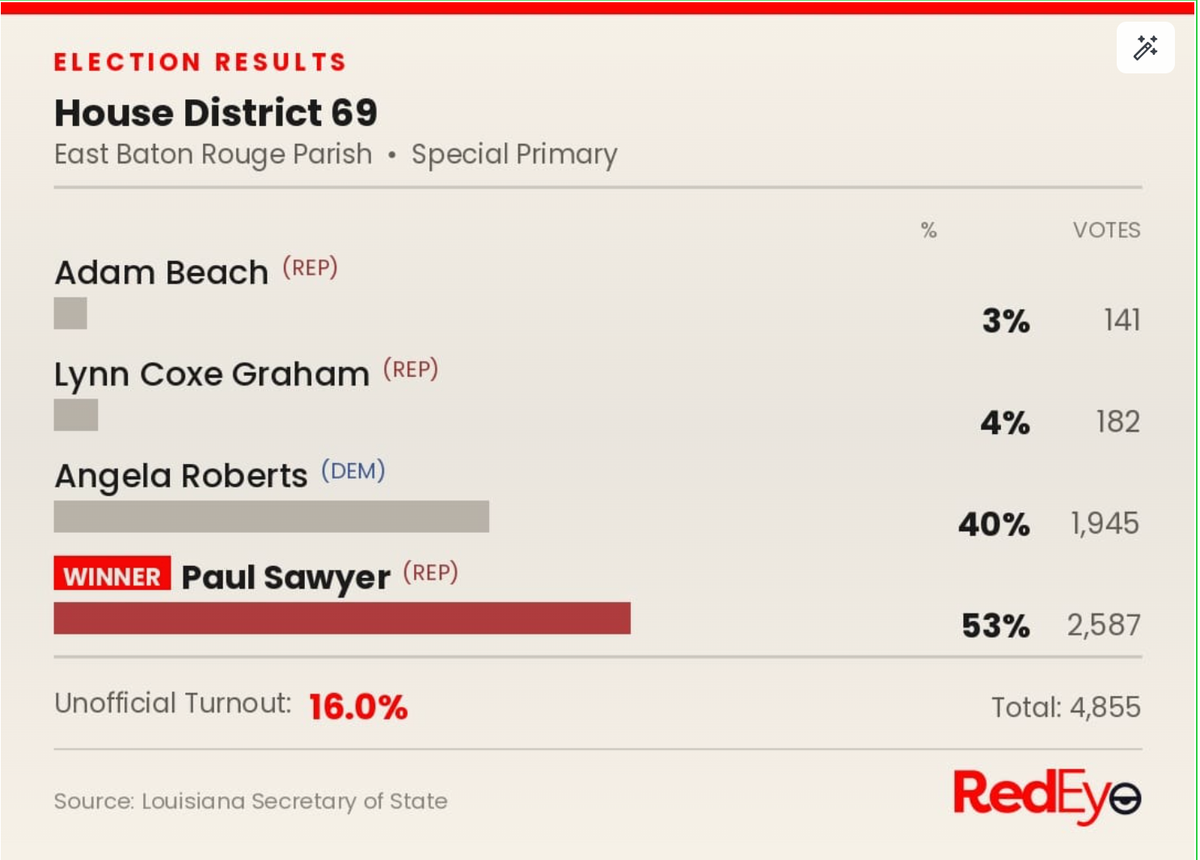
A special primary election was held Saturday in House District 69—the seat covering parts of Baton Rouge and St. George left vacant when Rep. Paula Davis resigned in January—and 84% of registered voters chose not to exercise their right.
Republican Paul Sawyer won outright with 53%, avoiding a runoff. Most residents probably didn't know the election was happening.
Why it matters: Louisiana holds more standalone election dates than almost any state in the country. The 16% turnout in District 69 wasn't an anomaly—statewide special elections in February drew between 13.8% and 14.5%.
The data: Research is unambiguous: off-cycle elections suppress turnout while amplifying the influence of organized special interests over ordinary voters. The electorate that does show up skews older, wealthier and more politically connected than the broader population those representatives are chosen to serve.
Hard truth: If 20- and 30-somethings vote, the odds increase of elected officials taking their desires more seriously.
A common strategy: It's not just legislative vacancies—taxing agencies across East Baton Rouge routinely schedule tax renewal and millage elections on low-turnout dates. It’s a quiet strategy that tends to produce quiet victories.
The fix: Election consolidation—stacking special and municipal elections onto existing high-turnout dates rather than calling standalone votes—consistently boosts participation by 8 to 18 percentage points, according to MIT Election Lab research. Some states have seen gains of up to 50 points. California moved in this direction and it worked. LABI has formally backed reducing the number of election dates. Reformers across the political spectrum agree.
The bottom line: The obstacle isn't ignorance—it's incentive. Low-turnout elections are easier to win for candidates with organized bases and institutional backing. The politicians and agencies that would have to change the system are often the ones who benefit from it. Until Louisiana consolidates its election calendar, the loudest voices in any given race will belong to the smallest slice of the electorate—and that's not an accident.